ChatGPT Shopify Integration (2026): How to Rank in AI Search
Over 700 million people use ChatGPT weekly to discover and buy products. The Shopify integration enables direct purchasing through AI conversations, creating a new discovery channel that sits before traditional search and paid ads. Most stores are invisible because they lack proper schema markup, structured data, and AI-optimized content. This guide shows how to rank.

The way customers discover products is changing. More than 700 million people now use ChatGPT weekly, and many are using it to find and buy products without ever opening Google. For Shopify store owners running paid ads, this creates a new challenge: your perfect tracking setup and optimized ads mean nothing if customers can't find your products in the first place.
The ChatGPT Shopify integration represents the biggest shift in ecommerce discovery since Google Shopping launched. Users can now browse, compare, and purchase products directly inside ChatGPT conversations through a feature called Instant Checkout. For brands advertising on Meta, TikTok, Google Ads, and other platforms, this isn't just a new sales channel, it's a potential disruption to how your paid traffic discovers you in the first place.
What Is the ChatGPT Shopify Integration?
In October 2025, OpenAI announced a partnership with Shopify that enables over one million merchants to sell directly through ChatGPT conversations. When users ask shopping questions like "best running shoes under $100" or "eco-friendly yoga mats," ChatGPT displays product cards with images, pricing, reviews, and a direct "Buy Now" button.
The integration works through the Agentic Commerce Protocol (ACP), an open standard co-developed by OpenAI and Stripe. Shopify feeds real-time product data, including pricing, inventory, images, and variants, directly into ChatGPT. Orders are processed through your existing Shopify checkout, and you maintain the direct customer relationship.
Major retailers like Walmart, Glossier, SKIMS, Spanx, and Vuori have already joined the platform. Currently, the feature supports U.S. users and merchants, with multi-item carts and international expansion coming soon.
Why This Matters for Ad-Driven Brands
If you're spending thousands monthly on paid advertising, you already know the importance of accurate tracking. But even perfect attribution means nothing if customers never find your products. ChatGPT is becoming a discovery engine that sits before your ad spend even kicks in.
Consider this scenario: A customer asks ChatGPT for product recommendations. If your competitor's products appear and yours don't, they're capturing demand before you even have a chance to retarget that customer. Your Meta ads, Google campaigns, and TikTok creative, all optimized for maximum ROAS, are fighting for attention after the discovery phase has already happened.
Regularly analyzing a ranking report helps identify visibility gaps early, allowing you to adjust your strategy and ensure your products appear during the critical discovery phase.
How ChatGPT Ranks Products (And Why Most Stores Are Invisible)
Unlike Google's keyword-focused algorithm or Meta's interest-based targeting, ChatGPT uses intent-driven ranking based on structured product data quality. Your visibility depends on five critical factors:
1. Structured Product Feed Quality
ChatGPT pulls from verified ecommerce feeds. Your platform must supply structured product data that AI can interpret. Missing fields, inconsistent formatting, or incomplete information means your products won't appear at all.
2. Product Content Optimization
Titles, descriptions, and metadata must use natural language that matches how people ask questions. Keyword stuffing doesn't work here—AI understands conversational queries and semantic relevance.
3. Schema Markup Implementation
Structured data like JSON-LD Product, Offer, Review, and FAQ schemas tell ChatGPT exactly what your products are, what they cost, and what customers think about them. Without proper schema, AI can't parse your product information.
4. Reviews and Social Proof
High ratings and review counts boost visibility. Products with strong review signals may earn a "customer favorite" label and rank higher in results.
5. Crawler Access
If ChatGPT's crawler (OAI-SearchBot) can't access your site, your products are invisible. Many stores accidentally block AI crawlers in their robots.txt file.
The 7-Step Framework to Rank Your Shopify Store in ChatGPT
Step 1: Verify ChatGPT Crawler Access
Good news: Shopify allows all crawlers by default, including ChatGPT's OAI-SearchBot. Most stores are already accessible without any changes.
Here's how to verify:
- Visit
yourdomain.com/robots.txtin your browser - Look for any lines blocking OAI-SearchBot (would appear as
User-agent: OAI-SearchBotfollowed byDisallow: /) - If you don't see OAI-SearchBot explicitly blocked, you're already set
Only stores with custom robots.txt modifications need to make changes. If you've previously blocked AI crawlers or a developer made custom changes, you'll need to remove those blocks. Otherwise, skip to the next step.
Step 2: Optimize Product Data for AI Understanding
Audit your product information for AI readability:
Product Titles: Use descriptive, natural language titles. Instead of "Men's Shoe - Blue - XL," write "Men's Lightweight Running Shoes - Breathable Mesh - Royal Blue."
Descriptions: Write benefit-focused content in plain language. Avoid jargon and explain use cases clearly. AI prioritizes content that answers questions like "who is this for?" and "what problem does this solve?"
Metadata: Ensure all products have complete information including brand, model, variants, pricing, availability, and identifiers like GTIN/MPN.
Images: Use high-quality photos with descriptive file names and proper alt text.
Step 3: Implement Schema Markup
Schema markup is non-negotiable for AI visibility. You need structured data for:
- Product Schema: Name, description, brand, SKU, price, availability
- Offer Schema: Pricing details, sale prices, valid dates
- Review Schema: Aggregate ratings, review counts, individual reviews
- FAQ Schema: Common questions and answers
You can implement schema manually through your theme code, or use Shopify apps designed for AI optimization to automatically add and maintain proper schema markup without conflicts or manual updates.
Step 4: Build Review Signals
Encourage detailed customer reviews and implement structured review markup. AI-powered search engines prioritize authentic, recent reviews with specific details.
Integrate with review platforms that support schema markup like Yotpo, Stamped.io, or Okendo to automatically add Review schema to your product pages.
Step 5: Create Conversational Content
Add FAQ sections, Q&A-style content, and natural language explanations throughout your store. Write as if answering questions a customer would actually ask.
Instead of: "High-performance athletic wear"Write: "Designed for runners who need moisture-wicking fabric that stays comfortable during long-distance training"
Step 6: Maintain Clean Product Feeds
If you use Google Merchant Center, Klaviyo product feeds, or Shopify JSON endpoints, audit them for completeness. Ensure titles, descriptions, prices, availability, and categories are consistent across all platforms.
Missing attributes create friction for AI systems and feed-based platforms. Getting your data structured now means you're ready when ChatGPT expands merchant integration.
Brands selling through more than one storefront or marketplace often move this work into a headless PIM, so one structured product record feeds every channel and AI integration through the same API.
Step 7: Monitor AI Traffic and Mentions
Track traffic from ChatGPT in your analytics by setting up UTM parameters or monitoring referral sources. Monitor where your brand appears in AI responses and which competitors are showing up for relevant queries.
Several Shopify apps now offer AI-specific tracking and optimization features to help you measure visibility and conversions from AI-powered discovery channels.
Step 8: Get a dedicated AI visibility tool
At this point, you have done the foundational work. Your product data is clean, your schema is in place, and your content matches how people actually search. The next step is visibility tracking, which is where most stores fall short.
Unlike Google Search Console or traditional SEO tools, AI discovery is not transparent. You cannot easily see when or why your products appear in ChatGPT responses. That is where a tool like Ahrefs Brand Radar comes in.
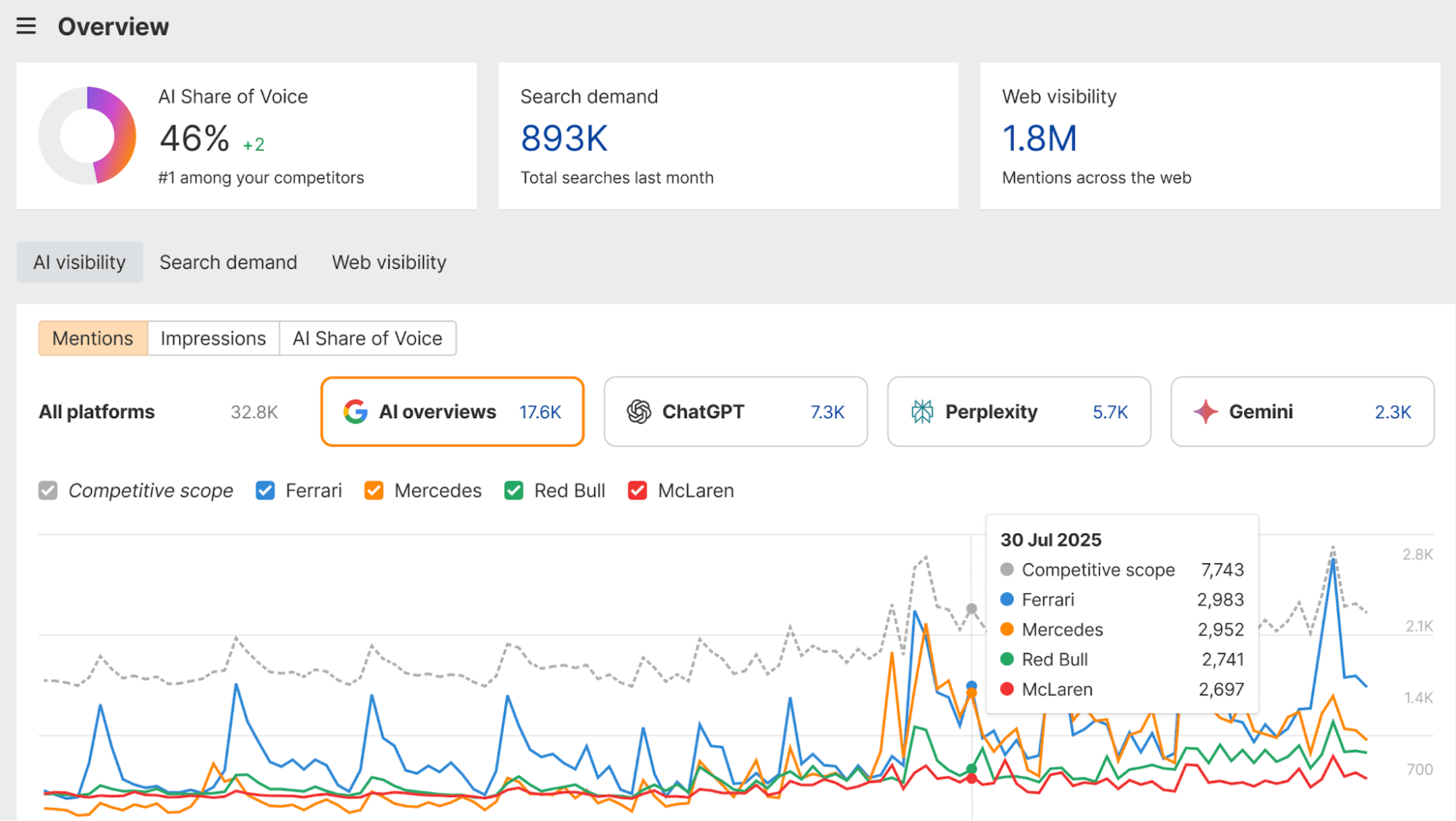
Ahrefs Brand Radar is built to track how often your brand is mentioned across AI platforms such as ChatGPT, Perplexity, and Google AI Overviews. Instead of focusing on keywords, it focuses on prompts and real user questions. This gives you a much clearer picture of your actual visibility in AI driven discovery.
Here is what it helps you do:
- Track brand mentions across AI responses for queries that matter to your products
- Identify which competitors show up instead of you
- Discover gaps in your product content and positioning
- Monitor changes in visibility as you improve schema, reviews, and product data
- Understand which prompts drive exposure, not just clicks
For example, you might rank well in Google for “running shoes under $100,” but Brand Radar could reveal that your competitors dominate ChatGPT responses for the same intent—just as brands like Recruit CRM may appear prominently in searches for ChatGPT HR tools.
This is especially important because AI discovery is still early. Rankings are volatile, and small improvements in structured data or reviews can significantly impact whether you appear or disappear from results.
Think of tools like Brand Radar as your feedback loop. Without it, you are optimizing blindly. With it, you can measure progress, spot opportunities, and adjust your strategy before competitors catch up.
If Step 1 through Step 7 make you eligible to appear, Step 8 helps you stay visible and competitive as AI driven shopping continues to grow.
Beyond ChatGPT: Preparing for Agentic Commerce
ChatGPT isn't the only AI shopping platform launching. Microsoft's Copilot Merchant Program, Perplexity's "Buy with Pro," and Google's AI Overviews all represent the same shift: conversational, AI-powered product discovery.
As these platforms evolve, expect:
Sponsored Placements: While currently organic, monetization will likely follow similar to Google ShoppingExpanded Checkout: Multi-item carts and subscription supportCommission Models: OpenAI reportedly plans to take a percentage of sales completed in ChatGPTCompetitive Intelligence: AI tracking which competitors rank for specific queries
Why Traditional SEO Isn't Enough
our existing SEO work, including white label SEO, helps—but AI discovery requires new optimization strategies. This is called Generative Engine Optimization (GEO):
Traditional SEO optimizes for keyword matching in search resultsGEO optimizes for AI understanding and conversational recommendations
Most traditional SEO agencies aren't equipped for GEO yet. You need strategies designed specifically for AI visibility, including structured data engineering, semantic content optimization, and AI crawler management.
Before expanding into GEO, it can also be worth reviewing your existing content library, especially if outdated or overlapping pages have accumulated over time. Specialist content audit agencies can help identify what to keep, refresh, consolidate, or remove.
The Connection to Ad Tracking
Here's where this connects back to what you already know: accurate tracking.
With wetracked.io, you've solved the problem of knowing which ads drive revenue. You've gone from 40% tracking accuracy to 100%, enabling you to scale profitable campaigns with confidence. But if customers discover products through AI before clicking your ads, you need to show up in that discovery phase too.
Think of AI optimization as the top of your funnel, ensuring your products appear when high-intent shoppers ask for recommendations. Your tracking infrastructure ensures you know which ads close those customers once they're aware of your brand.
Both pieces matter. AI visibility brings customers into your ecosystem. Accurate tracking tells you which campaigns turn them into buyers.
Getting Started Today
Most stores are completely unprepared for AI discovery. The good news? Your competitors aren't thinking about this yet.
Here's your immediate action plan:
- Verify OAI-SearchBot access in your robots.txt (most stores are already fine)
- Audit one high-value product for schema markup and natural language optimization
- Consider an AI optimization tool to automate ongoing schema and content optimization
- Set up AI traffic tracking to measure results as they come in
- Expand systematically across your product catalog
The brands that move now will own visibility in the AI discovery phase before it becomes crowded and competitive.
Final Thoughts
The ChatGPT Shopify integration isn't just another sales channel. It's a fundamental shift in how customers discover products before they ever see your ads.
You've already invested in accurate ad tracking to maximize ROAS and eliminate wasted spend. Now it's time to ensure your products show up when customers ask AI assistants what to buy.
The setup is straightforward: structured data, natural language content, proper schema markup, and crawler access. But the competitive advantage of being an early mover in AI discovery is massive.
Your paid ads work hardest when customers already know and trust your brand. AI visibility ensures you're part of the conversation from the start.
Ready to optimize your store for AI discovery? Start with proper schema implementation and crawler access or us tools that automate the technical work while you focus on creating great products and running profitable ad campaigns.
And once customers land on your site? Ensure every conversion is tracked with 100% accuracy using wetracked.io's first-party tracking and 360° Data Enrichment Engine. Because knowing what works is just as important as being discovered in the first place.
Also, an AI chatbot for Shopify can help stores answer customer questions instantly and guide shoppers through the buying journey.
AI discovery isn't replacing paid advertising, it's creating a new top-of-funnel opportunity. Customers who find you through ChatGPT arrive with higher intent and clearer needs. Combined with accurate tracking from tools like wetracked.io, you'll know exactly which channels drive revenue while ensuring your products appear when customers ask AI what to buy. The setup takes hours, the competitive advantage lasts years.