.png)
RedTrack and Voluum are two of the biggest names in the affiliate tracking space. Both can track paid campaigns, attribute conversions, pass conversion data back to ad platforms, and manage complex affiliate campaigns.
But they are built around slightly different priorities.
RedTrack is generally the better choice for advertisers that care most about tracking accuracy, conversion API connections, multi-channel attribution, and sending conversion data back to platforms such as Facebook and Google.
Voluum is stronger when you need advanced traffic distribution, detailed affiliate campaign management, an anti-fraud kit, and more control over how visitors move between landing pages and offers.
This RedTrack vs Voluum comparison covers tracking, reporting, automation features, integrations, customer journey visibility, pricing, and usability. It is written for affiliates, media buyers, agencies, and ecommerce advertisers deciding which tracking software makes more sense in 2026.
Try the better alternative to RedTrack and Voluum for accurate ad tracking. Get wetracked.io for free for 14 days.
TL;DR
Choose RedTrack if attribution and CAPI are your priority. It gives advertisers unlimited campaigns, server-side conversion sharing, customer journey reporting, and integrations with major ad platforms.
Choose Voluum if campaign control matters more. Its traffic distribution system, Traffic Distribution AI, Automizer, and Anti Fraud Kit give experienced affiliates more ways to manage traffic.
RedTrack also starts at a lower price, while Voluum places campaign limits and event limits on its lower plans.
If neither feels right, you can also compare our guides to the best Voluum alternatives and RedTrack alternatives.
RedTrack vs Voluum at a glance
Both Voluum and RedTrack are cloud-based tracking platforms designed around performance marketing. Neither requires self-hosting, so you do not need to maintain your own tracking infrastructure.
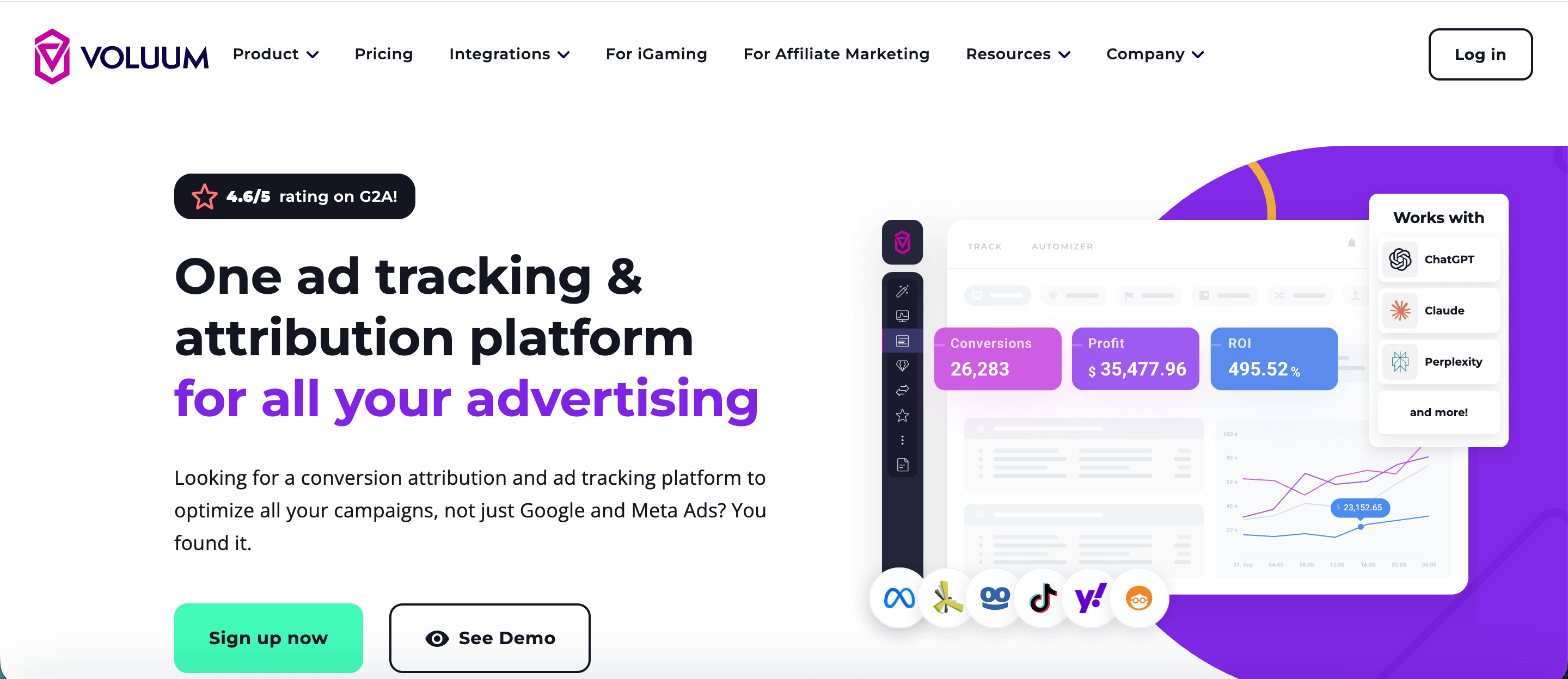
Voluum has stronger roots in affiliate tracking and media buying. Its structure revolves around traffic sources, landing pages, offers, campaign flows, and routing rules.
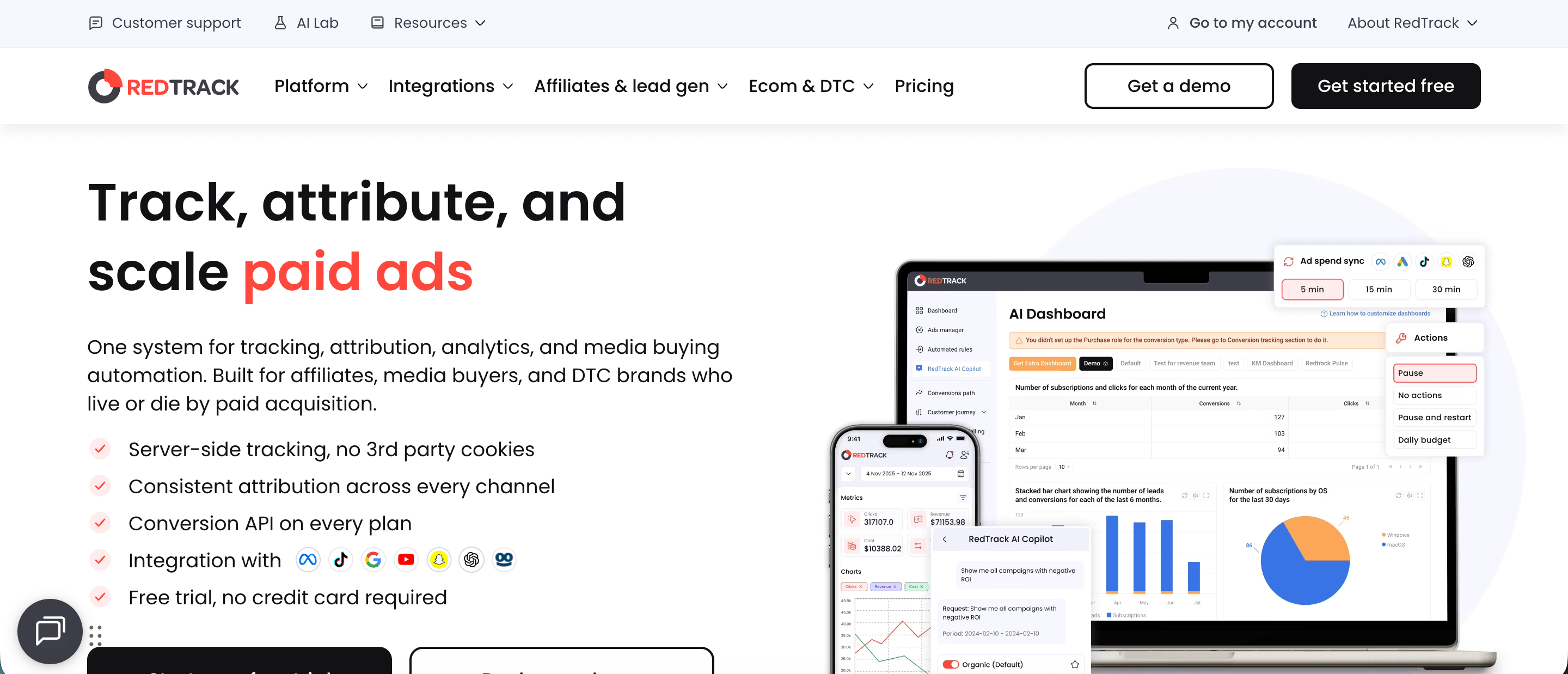
RedTrack works in many of the same scenarios, but the platform now puts more emphasis on server side tracking, ecommerce attribution, CAPI reliability, customer journeys, and conversion feedback.
The main distinction comes down to what you want to do after collecting the data.
Choose Voluum if the tracker itself needs to become a campaign management layer.
Choose RedTrack if accurate attribution and conversion feedback across several ad platforms are more important.
RedTrack vs Voluum: attribution accuracy
Tracking accuracy is difficult to compare directly because neither company publishes independent data proving that it universally records more conversions than the other.
Technically, both platforms offer ways to avoid relying entirely on browser-based pixels.
RedTrack supports first-party tracking, server-side tracking, scripts, postbacks, and API integrations. Its attribution system combines several data points when determining which campaigns should receive credit for conversions.
RedTrack also handles duplicate conversions internally. This helps prevent repeated postbacks from inflating your reports.
Voluum supports redirect tracking, direct tracking, pixels, postbacks, and API based conversion tracking. Cookie-less tracking can work through postbacks, first-party cookies, and direct integrations.
Ad blockers and browser restrictions therefore do not automatically make either tracker useless.
For advertisers spending heavily through Google Ads and Facebook, RedTrack has the cleaner full CAPI proposition. Conversion API support is closely tied to the core product rather than being treated as a secondary feature.
CAPI reliability still depends on correct setup. Poor event mapping or incorrect attribution settings can produce bad data regardless of which software you use.
Data sources and tracking setup
Voluum gives experienced affiliates a high level of control over campaign structure.
A campaign can contain traffic sources, offers, landing pages, campaign flows, conversion events, and custom variables. Traffic can then be routed according to factors such as country, browser, carrier, or language.
This is useful when a media buyer buys traffic from several networks and needs visitors sent to different offers.
Traffic Distribution AI adds another layer of automation. Instead of keeping the same traffic distribution percentages indefinitely, Voluum can adjust allocation according to recent campaign performance.
RedTrack supports many of the same concepts, including campaigns, landers, offers, traffic sources, conversion events, and routing rules.
Its stronger point is the connection between tracking data and mainstream advertising platforms.
RedTrack can pull ad spend into its reports through API integrations and automatically sends conversion information back to supported platforms.
That can reduce setup friction for advertisers whose campaigns live mainly inside Google Ads, Meta, TikTok, and similar platforms.
There is still manual setup involved with both tools. Events need to be mapped correctly, tracking domains need configuration, and advertising accounts need to be connected.
Voluum gives you more control over traffic routing. RedTrack gives you deeper integration with the advertising platforms receiving your conversion data.
Reporting and dashboard experience
RedTrack reporting goes beyond basic affiliate campaign reports.
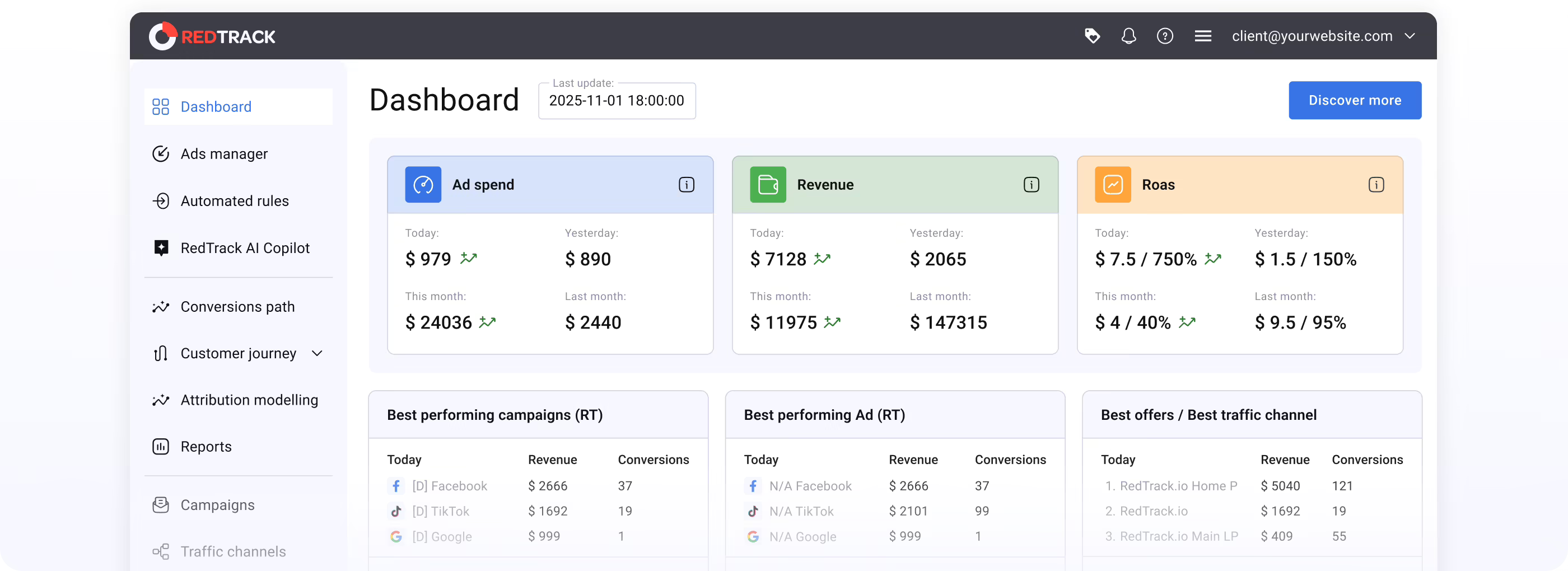
Its reports cover campaign performance, conversion paths, customer journeys, attribution, products, ad spend, revenue, and raw tracking data.
That becomes useful when the same business runs campaigns across several ad platforms.
Instead of comparing Google data with Facebook reports and then checking store data separately, RedTrack can act as an independent attribution source.
Voluum is very strong when you want to dig into campaign data.
Reports can use variables passed from the traffic source, allowing affiliates to evaluate performance by placement, device, publisher, or other campaign parameters.
The better reporting system depends on what you are trying to understand.
An affiliate may care most about discovering that one placement from one traffic source generates profitable conversions.
An ecommerce advertiser may care more about understanding how several paid channels contributed to purchases.
Voluum is stronger for the first scenario. RedTrack gives you more visibility into the second.
Marketing mix modelling and incrementality testing
Neither platform should be your first choice if marketing mix modelling or true incrementality testing is the main goal.
Their core function is attribution. They tell you which campaigns, clicks, or traffic sources are associated with conversions.
Attribution does not automatically prove incrementality.
Voluum does provide useful optimization tools through Traffic Distribution AI. It can adjust traffic distribution based on how different landing pages or offers are performing.
Automizer adds campaign automation rules.
You can create automation rules that react to campaign conditions. A campaign could be paused after reaching a certain threshold, for example.
RedTrack has its own automation features.
Stop Rules are included with its core plans. More advanced Scale Rules and Ads Manager capabilities are available depending on the plan and configuration.
Both tools can therefore help you respond to performance data.
Neither can definitively tell you whether a conversion would have happened without the ad.
Creative analytics
Creative analytics is not one of Voluum's main selling points.
You can still analyze creative performance by passing the relevant creative identifier into your tracker. Voluum can then compare conversions, clicks, revenue, and other campaign data.
RedTrack has gone further by offering a dedicated Creative Analytics product.
This puts individual creatives next to performance data, making it easier to compare ads without treating creative IDs as another reporting variable.
For an affiliate mainly testing landing pages, offers, and traffic sources, Voluum already provides plenty of reporting depth.
For advertisers testing large numbers of Facebook or TikTok creatives, RedTrack provides a more dedicated option.
Customer journey visibility
This is one of the clearer differences between RedTrack and Voluum.
Voluum is very good at tracking what happens inside an individual campaign. You can analyze visits and conversions using the parameters collected by the tracker.
RedTrack puts more emphasis on customer journeys across several channels.
Its reporting can connect ad interactions and conversions into a sequence leading to a purchase. Ecommerce users can also analyze customer level activity and cohorts.
Consider someone who first discovers a product through Facebook, later searches on Google, and eventually purchases during another visit.
A simple last click model can give all the credit to the final source.
Customer journey reporting gives you more context around what happened before that conversion.
Voluum remains more campaign centric.
For affiliates sending paid traffic directly into an offer funnel, that may be exactly what they need.
For brands with longer buying journeys, RedTrack gives you more visibility.
Integrations
Both platforms support major traffic sources and advertising platforms.
RedTrack uses API integrations for reporting and conversion sharing. It can pull campaign data into RedTrack while also sending conversion signals back to advertising platforms.
Conversion API support is one of RedTrack's biggest advantages.
RedTrack supports CAPI connections with platforms including Meta, Google, TikTok, and Snapchat. CAPI included within the main tracking product means you do not need an enterprise plan just to start sending server-side conversion data.

Voluum also supports integrations with major traffic sources through Automizer.

These integrations can synchronize campaign information, pull costs, and let users manage supported campaigns from Voluum.
Voluum also supports server-side conversion sharing with platforms such as Facebook and Google.
So this is not a situation where one tracker has CAPI and the other does not.
RedTrack treats conversion feedback as a central part of the product. Voluum combines it with a wider affiliate campaign management system.
Ease of setup and use
Neither tool is something you install in five minutes and forget about.
Voluum has a learning curve because you need to understand how traffic sources, landers, offers, campaigns, flows, postbacks, and tracking parameters interact.
For an experienced affiliate, that complexity can be useful.
For a small team that mainly wants better paid ad attribution, it can create unnecessary setup friction.
RedTrack's learning curve should not be ignored either.
Affiliate campaigns still require technical configuration, and advanced attribution means understanding event definitions, conversion settings, domains, and data sharing.
The learning curve pays off in different ways.
Voluum gives advanced affiliates more control over campaign routing.
RedTrack gives advertisers more direct control over attribution and the conversion data sent back to ad platforms.
If your campaigns mainly revolve around Google Ads and Facebook, choose RedTrack.
If campaign routing and affiliate traffic management are central to your work, choose Voluum.
Pricing comparison
Pricing is another major difference in the RedTrack vs Voluum decision.
RedTrack currently starts with Builder at $69 per month. Solo starts at $141, Team at $333, and the Enterprise plan at $833 based on annual billing.
Builder includes 2 million monthly events. Solo includes 5 million, Team includes 20 million, and Enterprise increases this to 75 million.
RedTrack includes unlimited campaigns even on its entry plan.
That can make a big difference for affiliates who run many campaigns but do not generate massive event volumes.
RedTrack still has event limits and user limits. Data retention also increases as you move into higher tiers.
You can see every plan in our full RedTrack pricing breakdown.
Some RedTrack features can also become separate costs. Faster ad spend synchronization, Ads Manager, Scale Rules, Creative Analytics, and additional users can affect the final price.
This means the advertised starting price may not represent what a larger media buyer eventually pays.
Voluum starts higher.
Profit costs $149 with monthly billing or $119 per month with annual billing. Scale costs $349 monthly or $299 with annual billing.
The Start-up plan costs $599 monthly or $539 with annual billing.
Higher tiers are aimed at agencies and larger advertisers.
You can see the full limits and pricing in our Voluum pricing guide.
Voluum also imposes campaign limits.
Profit supports 20 active campaigns and 1 million monthly events. Scale increases that to 60 campaigns and 5 million events. Startup includes 100 campaigns and 10 million events.
Overage fees apply after you exceed the included event limits.
Automizer also has separate ad spend allowances, which can raise the total cost for advertisers using more advanced automation features.
RedTrack handles automation differently. Stop Rules are included, while additional automation and faster cost updates depend on the plan and add ons you select.
There is also a free plan of sorts from RedTrack.
Relay provides free Conversion API access for one store and one user across Meta, TikTok, and Snapchat. No credit card required.
Relay is not the complete RedTrack tracker, though. It does not give you full attribution reports or the complete set of RedTrack features.
For a solo media buyer, RedTrack can offer more tracking capacity for the money at the entry level.
Voluum becomes easier to justify when advanced traffic distribution, Traffic Distribution AI, affiliate tracking controls, and its anti-fraud tools are central to your campaigns.
Voluum vs RedTrack: which one should you get?
Both Voluum and RedTrack are capable trackers, but each makes more sense for a different type of advertiser.
Voluum remains one of the strongest tools for advanced affiliate tracking.
RedTrack has moved further toward attribution, CAPI, and conversion feedback for advertisers using major ad platforms.
Your final recommendation should depend on how your campaigns work.
Choose Voluum if...
- You run a large number of affiliate campaigns across different traffic sources.
- You need advanced traffic distribution and routing rules.
- You want Traffic Distribution AI to adjust traffic allocation automatically.
- You need Voluum's Anti Fraud Kit.
- You rely on granular affiliate reports and custom campaign variables.
- You want campaign automation rules through Automizer.
- You are comfortable with a steeper learning curve in return for more campaign control.
- Your priority is affiliate traffic management rather than multi channel attribution.
If most of these points describe your setup, choose Voluum.
Choose RedTrack if...
- You spend heavily through platforms such as Facebook and Google Ads.
- Full CAPI and server side conversion sharing are major priorities.
- You want unlimited campaigns rather than lower plan campaign limits.
- You need multi channel attribution and customer journey reporting.
- You want safeguards against duplicate conversions.
- Longer data retention matters to your team.
- You want affiliate tracking alongside ecommerce attribution.
- You prefer RedTrack's deeper integration with mainstream ad platforms.
If this sounds closer to your use case, choose RedTrack.
Get wetracked.io instead
RedTrack and Voluum both give experienced marketers a large amount of control.
The downside is that you may end up paying for tracking features your business never touches.
If you run a Shopify or WooCommerce store and your main issue is inaccurate paid ad conversion tracking, wetracked.io offers a more focused alternative.
Wetracked.io uses first-party tracking and server-side conversion forwarding to reduce data loss caused by ad blockers and browser restrictions.
It supports major advertising platforms including Meta, Google Ads, TikTok, Snapchat, Pinterest, and X.
The setup is also different from a traditional affiliate tracker.
You continue to manage campaigns inside your existing ad platforms. Wetracked.io collects conversion data and automatically sends it back to those platforms rather than asking you to rebuild campaigns inside another piece of software.
Pricing is based mainly on monthly order volume instead of ad spend or tracked events.
The Starter plan costs $49 per month for up to 500 orders. Business costs $149 for up to 3,000 orders, while Scale up costs $249 for up to 7,500 orders.
All plans include unlimited ad spend and unlimited ad pixels per store.
Try wetracked.io free for 14 days and compare the tracking data for yourself.


%20(1).png)
.png)


