.png)
RedTrack works well for many advertisers, but it is not the best fit for every team. You may want a simpler setup, stronger attribution, better ecommerce reporting, or a platform that fits your budget more comfortably.
This guide is for affiliate marketers, media buyers, ecommerce brands, and performance teams comparing RedTrack with other tracking platforms. We cover the best RedTrack alternatives, where each one is stronger, what it does differently, and the tradeoffs to know before switching.
TL;DR
- wetracked.io: Best for ecommerce brands that want accurate conversion tracking, easier setup, and lower starting costs.
- Cometly: Best for B2B SaaS teams that need to connect paid ads with pipeline and closed revenue.
- Ruler Analytics: Best for companies with longer sales cycles and conversions that happen through forms or phone calls.
- Voluum: Best for affiliate marketers and media buyers who need deep campaign tracking and traffic optimization.
- AnyTrack: Best for marketers who want simple server side tracking and a free entry point.
- TrackBee: Best for Shopify brands that want fast setup and cleaner conversion data inside their ad platforms.
- Binom: Best for high volume media buyers who want self hosted tracking and full control over their data.
- Triple Whale: Best for ecommerce brands that want attribution tied to profitability and customer retention.
- SegMetrics: Best for SaaS and subscription businesses that care about lifetime value and longer customer journeys.
- Hyros: Best for businesses with high ad spend that want hands on onboarding and deeper tracking across calls and subscriptions.
Get the best RedTrack alternative for accurate ad tracking. Try wetracked.io for free today.
Why look for RedTrack alternatives in the first place?
RedTrack has made a name for itself, even among the enterprise-grade competitors. The ratings are solid (4.5/5 at G2 at the time of writing) but there are a few downsides to be aware of before taking it for a spin.
Here's what you should know.
The UX isn't the smoothest
While RedTrack does work, users report that the user interface and experience aren't very modern. It will get the job done, but finding the button and report you need might take you a few clicks and screens more than you'd like to.
"The UI feels dated and a bit clunky compared to newer tools, and some of the reporting views take more clicks than they should to get to the breakdown you actually want. Once it's configured it runs fine, but the initial setup is where most of the frustration lives."
And there's another similar review:
"Maybe the dashboard needs to improve. I believe RedTrack.io needs to not only improve the UX of the platform, but also allow users to create personal dashboards and visualize campaign information with a better visual and UX, like seeing graphics more easily. The initial setup was hard because RedTrack.io has a different way to integrate with the platforms we sell our products."
This, on top of RedTrack pricing, is one of the most common reasons why users switch from this platform.
You can't customize the reports (too much)
If you want to send your ad spend reports to a CMO or a client, you can't use RedTrack to customize the design as much as you'd want to. If your main goal is to present the information in a clear way, it won't be a huge issue. However, if you want to white-label your reports as an agency, this can be a dealbreaker.
Here's what one reviewer said:
"Perhaps the aspect I like the least is that it does not allow any kind of design customization. For a platform you use daily, it would be nice to make it feel more "personal" both in colors and by changing logos, even being able to use a personalized URL for the panel. These are cosmetic changes, but they would be very appreciated."
Some reports can take a bit of time to load
If you're working with large data sets, RedTrack can slow down and cause issues with data accuracy.
The best RedTrack alternatives for accurate conversion tracking in 2026
If you're looking for something with more accurate conversion data and better server side tracking, there's good and bad news: there are plenty of competitors to RedTrack out there. Here are the very best to keep on your radar.
1. wetracked.io
wetracked.io is an ecommerce tracking platform for brands that want more accurate conversion data inside Meta, Google Ads, TikTok, Pinterest, Snapchat, and X. It is a more focused alternative to RedTrack, especially if you care more about sending reliable purchase data back to your ad platforms than managing complex attribution setups.
Why choose wetracked.io over RedTrack?
- Easier to set up for ecommerce: wetracked.io connects directly with Shopify, WooCommerce, and other ecommerce platforms. You do not need to build complicated tracking setups or rely on UTM parameters.
- Conversion data appears directly in your ad platforms: wetracked.io captures purchase data, enriches it with first party data, and sends those conversions back to your ad accounts. You can work with that data inside the platforms you already use.
- Lower starting price: wetracked.io starts at $49 per month for up to 500 monthly orders and three stores. RedTrack starts at $99 per month for its Brand plan.
- No limits based on ad spend or revenue: our pricing is based on monthly order volume. All standard plans include unlimited ad spend and tracked revenue.
- Multiple stores from the cheapest plan: the Starter plan includes up to three stores, which can make it a better deal for smaller ecommerce businesses running several storefronts.
- Built specifically for ecommerce tracking: wetracked.io focuses on tracking purchases and feeding better conversion data back to ad platforms. RedTrack includes many more features for affiliates, media buyers, and teams managing more complicated campaign structures.
The main downside is that wetracked.io does fewer things than RedTrack. If you need affiliate tracking, traffic routing, advanced funnel tracking, or broader campaign management features, RedTrack gives you more control.
2. Cometly
Cometly is a marketing attribution platform built primarily for B2B SaaS companies. While RedTrack serves ecommerce brands, affiliates, and media buyers, Cometly is better for companies that need to connect ad clicks with leads, pipeline, and closed deals across multiple platforms.
Why choose Cometly over RedTrack?
- Better suited to B2B attribution: Cometly connects advertising data with CRM activity and revenue, so you can see which campaigns generate qualified leads and paying customers rather than stopping at conversions.
- Stronger multi-touch attribution: Cometly lets you follow the complete account journey and compare different attribution models, which is useful when several campaigns influence a deal before it closes.
- Deeper CRM connections: Cometly integrates with tools such as HubSpot and Salesforce, allowing marketing teams to connect ad activity with lifecycle stages and revenue data.
- Better visibility across multiple platforms: You can bring data from Meta, Google, LinkedIn, TikTok, Microsoft, Reddit, and Snapchat into the same attribution setup, with unlimited ad platform connections included.
- Useful for longer sales cycles: Cometly can connect advertising touchpoints with later CRM activity, making it easier to judge ad networks based on pipeline and customer value instead of immediate purchases.
- Fits into a broader B2B marketing stack: Cometly offers more than 70 integrations and can send attribution data into other marketing tools, CRMs, and data warehouses.
The biggest drawback is Cometly pricing. Cometly does not publish fixed prices, and there is no free trial, so you need to speak with its sales team before you can properly compare costs.
It also has fewer integrations than RedTrack, which supports more than 200 integrations. RedTrack may therefore be the better option if you rely on less common ad networks or affiliate platforms.
3. Ruler Analytics
Ruler Analytics is a marketing attribution platform that connects website activity with leads, sales, and revenue. It is a better RedTrack alternative for companies with longer sales cycles, especially when conversions happen through forms, phone calls, or a sales team rather than directly on a website.
Why choose Ruler Analytics over RedTrack?
- Better lead and revenue attribution: Ruler follows individual customer journeys and connects marketing touchpoints with leads, opportunities, and closed revenue. This gives performance marketers accurate data on which ad campaigns actually contribute to sales.
- Built in call tracking: Ruler can track phone calls alongside forms and other conversions, then connect those interactions with the marketing source that generated them. This is useful for businesses where a large share of leads convert over the phone.
- Stronger CRM attribution: Ruler connects marketing data with CRM opportunity and revenue stages, helping teams trace revenue back to specific channels, campaigns, keywords, and landing pages.
- Better coverage of offline sales: Ruler can connect online marketing touchpoints with revenue that appears later in your CRM. This makes it easier to evaluate major ad networks based on actual won business rather than form fills alone.
- More options for measuring longer customer journeys: Alongside attribution models such as first click, last click, linear, and time decay, Ruler offers marketing mix modelling for measuring channels that are harder to track through clicks alone.
- Revenue data can be sent back to advertising platforms: Ruler can pass attributed revenue into tools such as Google Ads and Meta, giving campaign teams better conversion signals for optimization.
Ruler Analytics is much less appealing if you need the campaign management features RedTrack provides. It does not offer the same automatic traffic distribution, offer rotation, traffic routing, or affiliate management capabilities, so RedTrack is still better suited to affiliates and media buyers managing traffic across many sources.
Ruler can also get expensive. Its current pricing scales with monthly traffic and starts at several hundred dollars per month, while contracts are generally based on a twelve month agreement.
4. Voluum
Voluum is an ad tracker built for affiliate marketers and media buyers who need detailed campaign tracking across traffic sources, landing pages, offers, and affiliate networks. It competes closely with RedTrack, but Voluum can be the better choice when media buying and traffic optimization are the main priorities.
Why choose Voluum over RedTrack?
- More mature tools for affiliate marketers: Voluum was built around affiliate campaign tracking and supports templates for more than 50 traffic sources and more than 40 affiliate networks. It also tracks more than 30 data points for each event.
- Flexible traffic distribution: You can send visitors to different offers or landing pages based on rules you define. Voluum also offers automated traffic optimization for teams that want the platform to adjust distribution based on performance.
- Strong media buying automation: Voluum Automizer connects with supported traffic sources so you can create rules that react to campaign performance without constantly checking every network separately.
- Detailed event tracking: Voluum can track page views, ad clicks, landing page clicks, and conversions. It supports redirect tracking as well as direct tracking, so you are not limited to a traditional tracking pixel setup.
- Built in protection against bad traffic: Its Anti Fraud Kit is designed to flag suspicious visits and traffic sources, which can be useful when buying large amounts of traffic from affiliate and native advertising networks.
- More specialized reporting than Google Analytics: Voluum gives affiliate teams reporting built around campaign costs, offers, traffic sources, conversion data, and granular visit information rather than general website analytics. Raw traffic logs are also available for deeper analysis.
The biggest downside is price. RedTrack currently starts at $69 per month for affiliates and media buyers, while Voluum pricing has several advanced features and higher usage limits further up its pricing structure.
RedTrack also currently advertises more than 200 integrations and includes server-side conversion tracking for Meta, Google, TikTok, and other platforms on every plan. That can make RedTrack the better deal if broad platform coverage matters more than Voluum's affiliate-focused tracking and media buying tools.
Make sure to read our detailed comparison of RedTrack and Voluum too.
5. AnyTrack
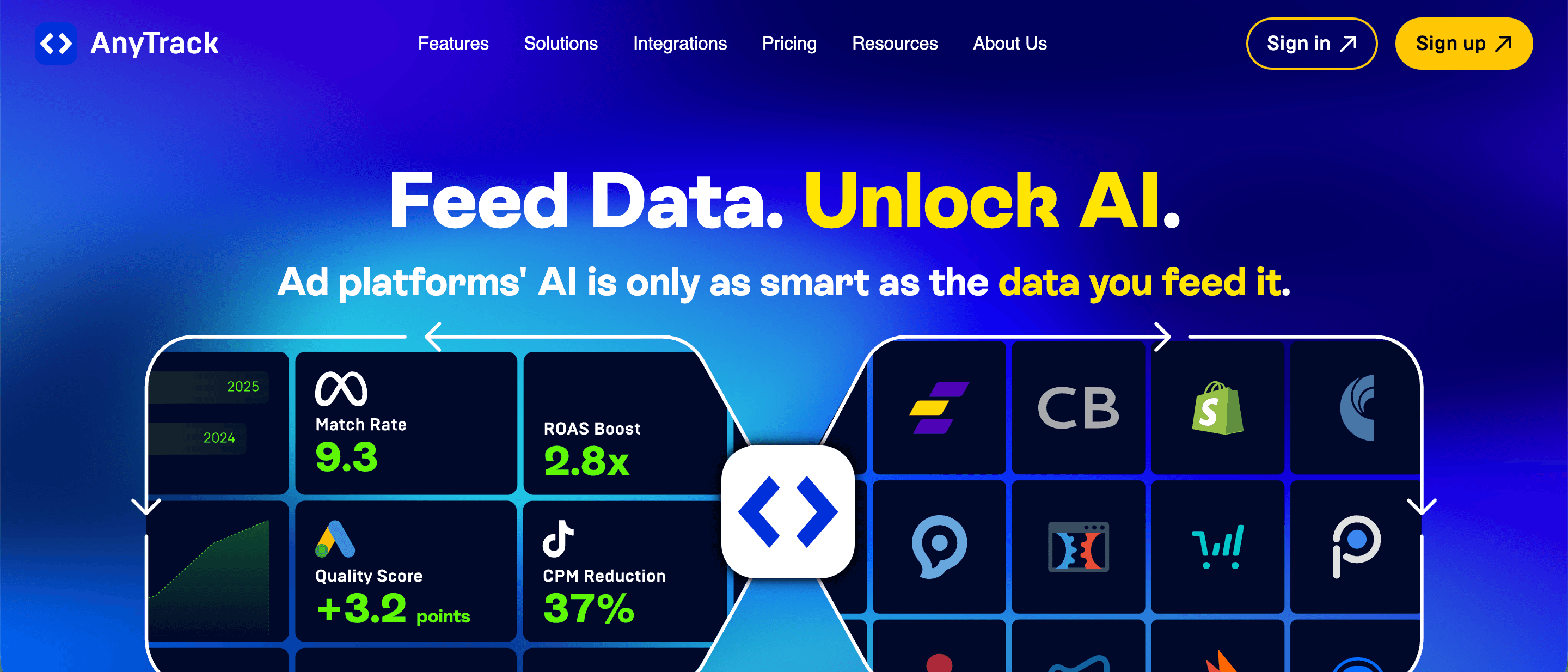
AnyTrack is a marketing measurement platform that tracks conversions across paid traffic, affiliate campaigns, ecommerce stores, and CRM activity. Compared with RedTrack, it is easier to approach if your main goal is getting accurate conversion data into your advertising platforms without also needing advanced traffic routing tools.
Why choose AnyTrack over RedTrack?
- Free plan available: AnyTrack has a free plan with 5,000 monthly sessions, one website, and one ad platform integration. RedTrack only offers a 14-day free trial before you need a paid plan.
- Simple server-side tracking: AnyTrack uses server-side tracking for its ad platform integrations and combines browser activity with conversion data from your store or CRM. This helps recover conversions that can otherwise be missed because of ad blockers or browser privacy restrictions.
- More than 100 integrations on the Starter plan: Once you move to the $100 per month Starter plan, AnyTrack gives you access to its full integration catalog. Its ad network integrations include Google Ads, Meta, TikTok, Microsoft Ads, Taboola, and Outbrain.
- Good option for ad agencies: AnyTrack has agency-focused tracking that lets teams manage attribution across client accounts while sending conversion data back to each client's advertising platforms. Its Advance plan supports 10 websites and multiple ad accounts.
- Useful cross-channel attribution: AnyTrack can connect paid traffic with conversions from affiliate networks or ecommerce stores. This gives marketers one attribution view without depending entirely on the numbers reported by each advertising platform.
- Easy ad network integrations: AnyTrack sends conversion events directly to connected advertising platforms through their native APIs, which reduces the amount of tracking code and platform specific configuration you need to maintain.
AnyTrack is not as strong if you need campaign management or traffic distribution. RedTrack offers tools for campaign rules and Smart Distribution that are better suited to media buyers who want to control where traffic goes from inside their tracking platform.
RedTrack also has an advantage for creative analytics. It offers a dedicated Creative Analytics add on, while AnyTrack focuses more heavily on attribution and conversion tracking.
Make sure to also read our review of the best AnyTrack alternatives.
6. TrackBee
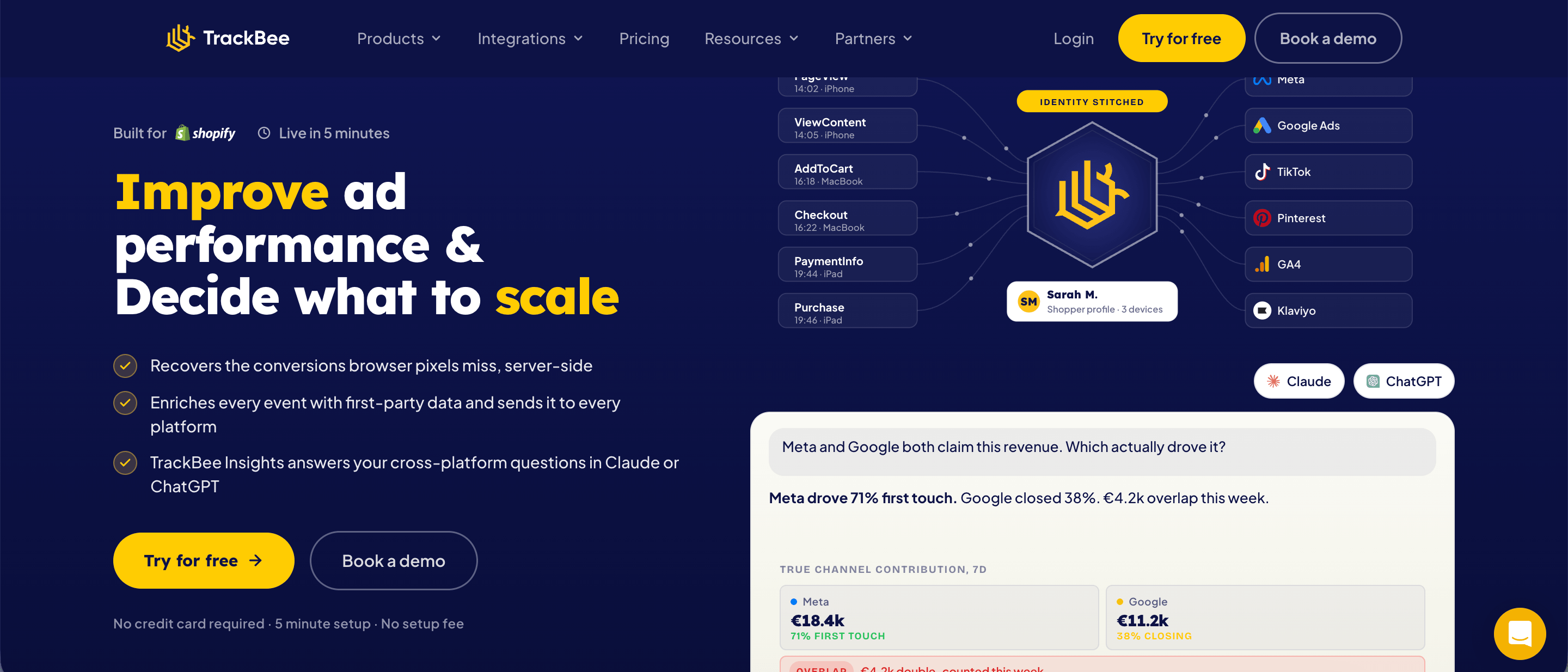
TrackBee is a Shopify tracking platform that captures conversion data on the server, enriches it with first party customer data, then sends it to Meta, Google, TikTok, Pinterest, GA4, and other connected platforms. It is a good RedTrack alternative for ecommerce brands that want better conversion tracking without a complicated technical setup.
Why choose TrackBee over RedTrack?
- Much easier setup: TrackBee says stores can get running in about five minutes without a developer, code changes, or Google Tag Manager. This makes it appealing if you want to avoid the manual setup that can come with more configurable tracking platforms.
- Built specifically for Shopify: TrackBee connects directly with Shopify and focuses on recovering missing ecommerce events, enriching customer data, and sending those events back to advertising platforms. RedTrack focuses on a much wider range of use cases, including ecommerce, affiliate marketing, and media buying.
- Cross channel reporting in one dashboard: TrackBee brings campaign performance from Meta, Google Ads, TikTok, and Pinterest together with Shopify order data. This gives ecommerce teams one dashboard for comparing channel performance instead of relying on the numbers inside each ads manager.
- Better data before attribution: TrackBee captures events on the server and builds persistent shopper profiles across sessions and devices. Its approach to multi-channel attribution starts by improving the conversion data being fed into each platform rather than relying only on browser tracking.
- All integrations included on every plan: TrackBee includes its supported integrations across all paid plans, so you do not need a higher tier simply to connect another supported advertising platform.
- Longer free trial: TrackBee currently offers a 30 day trial with no credit card required, while RedTrack offers a 14 day trial.
TrackBee is much narrower than RedTrack. It is primarily built for Shopify brands, while RedTrack gives performance marketers more control over campaigns, traffic distribution, affiliate tracking, and ads manager features.
Team access is another point to check. TrackBee does not publicly list unlimited users as a standard plan feature, while both RedTrack Brand and Agency plans include unlimited users.
7. Binom
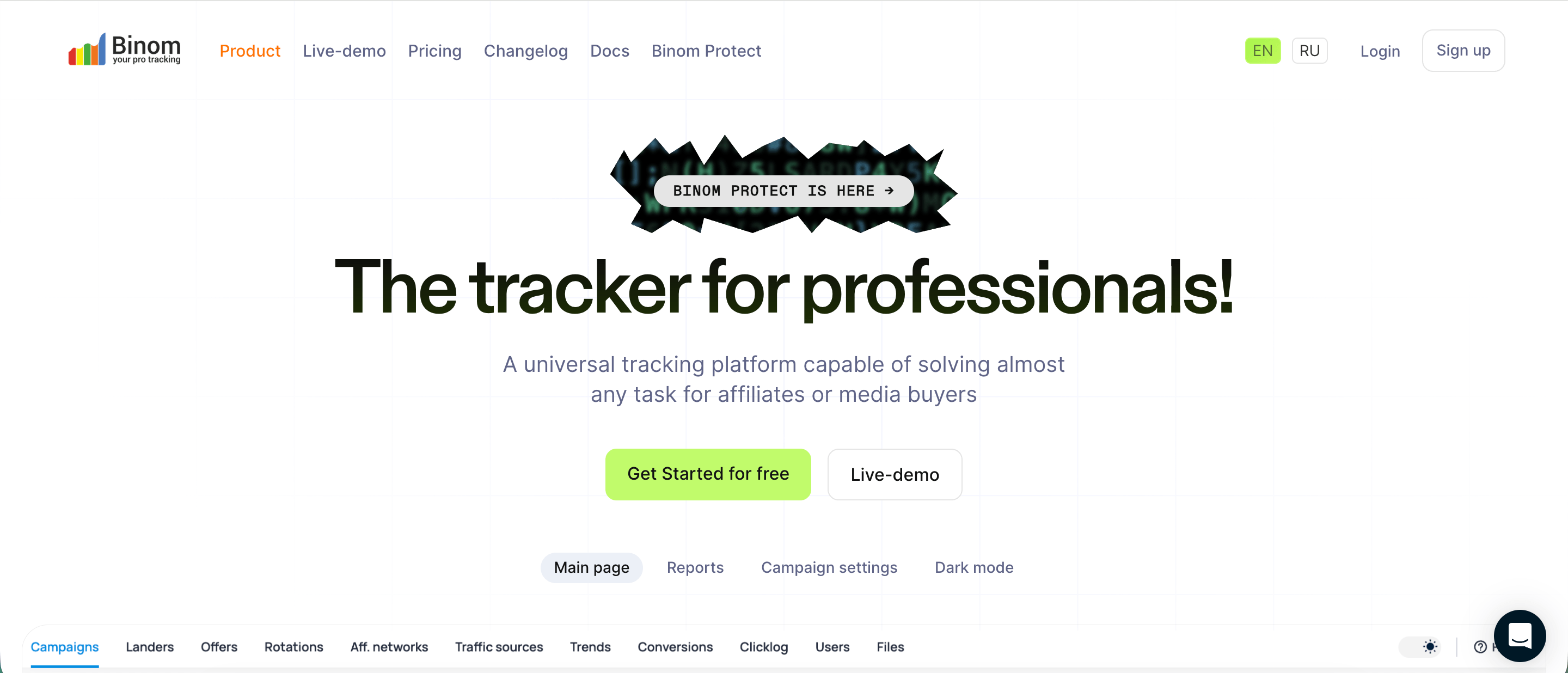
Binom is a performance tracking platform built mainly for affiliate marketers and media buyers who want fast reporting, flexible traffic routing, and full control over their tracking data. Unlike RedTrack, Binom can run on your own server, which makes it especially attractive to teams handling large traffic volumes.
Why choose Binom over RedTrack?
- No click limits: Binom charges a fixed price regardless of click volume and supports traffic of up to 260 million clicks per day on Binom v2. This can make costs easier to predict as you buy more traffic.
- Full control over your tracking data: Binom v2 is self hosted, so your campaign data stays on infrastructure you control rather than inside a managed tracking service.
- Strong traffic routing: You can split traffic between offers and landing pages while tracking detailed information about every click. This is useful for affiliates testing different funnels to find combinations that produce more conversions.
- Detailed click data: Binom can capture 30 click parameters, including location, connection type, ISP, bot status, and other information that helps media buyers analyze traffic quality.
- Unlimited users and domains: The standard Binom v2 plan includes unlimited users and domains, which can be useful for larger teams managing many campaigns.
- Lower price with annual billing: Binom v2 costs $149 per month or $104 per month when paid yearly, which is a 30 percent discount.
Binom is less appealing for e commerce and DTC brands that rely heavily on Meta, Google, or TikTok. RedTrack offers native conversion APIs, customer journey reporting, and ad set level spend syncing specifically for these use cases.
The self hosted version also requires you to manage your own server, while RedTrack handles the infrastructure for you. Teams that want minimal technical maintenance may prefer RedTrack despite Binom's greater control.
8. Triple Whale

Triple Whale is an ecommerce analytics and attribution platform that gives brands a much broader view of their business than RedTrack. Along with ad attribution, it brings in product performance, customer retention, profitability, creative performance, and store data, so marketing teams can see what happens after a customer converts.
Why choose Triple Whale over RedTrack?
- Better ecommerce analytics: Triple Whale goes much further than campaign attribution. Brands can analyze product performance, inventory, profitability, and customer behavior from the same platform.
- Stronger product reporting: Triple Whale lets you compare individual products and SKUs using metrics such as ROAS, contribution margin, and return rate. This is useful when you want to know which products are actually worth putting more ad spend behind.
- More useful retention reporting: Its cohort tools show how customer groups behave over time and how acquisition costs compare with customer lifetime value. RedTrack has cohort reporting too, but Triple Whale provides more depth for ecommerce teams focused on repeat purchases and retention.
- Built in post purchase surveys: Triple Whale can ask customers what influenced their purchase and use those responses alongside its attribution data. This gives brands another way to measure channels that are difficult to track through clicks alone.
- Deeper creative analysis: Triple Whale lets you compare creative performance across platforms and break results down by factors such as audience segment and device. RedTrack offers Creative Analytics as a paid add on rather than including it with its standard Brand plan.
- Free plan available: Triple Whale has a permanent free plan with channel reporting, first click and last click attribution, store metrics, and a post purchase survey. RedTrack gives you a 14 day trial, but there is no permanent free tier.
The biggest downside is price once you need Triple Whale's full attribution features. When it comes to Triple Whale pricing, Its Foundation plan starts at $219 per month, while RedTrack's Brand plan starts at $99 per month.
Triple Whale is also much more focused on ecommerce. Affiliate marketers and media buyers who need traffic routing, offer management, or campaign rules will find RedTrack more flexible.
9. Segmetrics

SegMetrics is a marketing attribution platform built around customer journeys, lifetime value, and revenue. It is a better RedTrack alternative for SaaS companies, subscription businesses, and lead generation teams that want to connect advertising with CRM activity, email engagement, purchases, and repeat revenue.
Why choose SegMetrics over RedTrack?
- Better lifetime value attribution: SegMetrics tracks customers beyond their first conversion, so you can see which campaigns bring in customers who purchase again or stay subscribed longer. This is especially useful when initial ROAS does not tell you much about long term customer value.
- More useful attribution for longer sales cycles: SegMetrics connects ad clicks with CRM contacts, sales activity, email engagement, and eventual revenue. You can switch between first click, first engagement, last touch, and full funnel attribution depending on what you want to measure.
- Historical data from your existing tools: SegMetrics can import historical information from connected marketing platforms, so you are not starting with an empty reporting account when you first sign up.
- Unlimited users on the entry plan: The $57 per month Launch plan includes unlimited users. RedTrack Builder starts at $69 per month and includes one user, with additional seats costing extra.
- Pricing is based on active contacts: SegMetrics charges according to the number of identified contacts you are actively engaging with rather than total website traffic or tracked revenue. Anonymous visitors do not count toward that limit.
- Connects more of the customer journey: SegMetrics currently lists 138 integrations covering advertising, CRM, email, ecommerce, payment, webinar, and other marketing platforms. This makes it easier to connect acquisition data with what customers do after they become leads.
SegMetrics is primarily an analytics and attribution product, so it does not give media buyers the same campaign control as RedTrack. RedTrack includes traffic distribution, offer and landing page management, campaign rules, and an Ads Manager, which makes it more useful for affiliate marketers who actively manage traffic from their tracking platform.
SegMetrics can also become expensive as your active contact count grows, so businesses with very large email or CRM databases should compare pricing based on their actual contact volume before switching.
10. Hyros
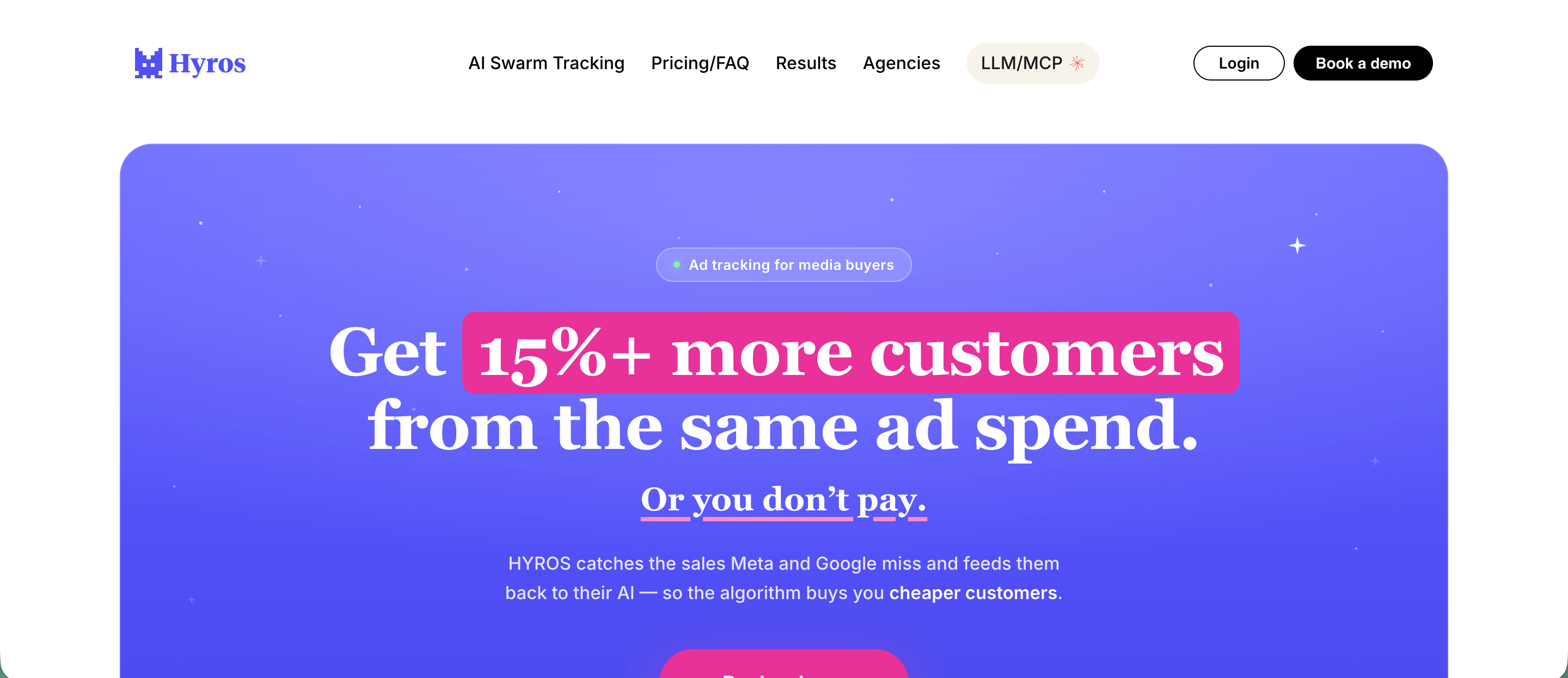
Hyros is an ad tracking and attribution platform built for businesses spending heavily on paid acquisition. It is a good RedTrack alternative for teams that want hands-on onboarding and deeper tracking across long customer journeys, including sales calls and subscription revenue.
Why choose Hyros over RedTrack?
- More hands on support from the start: Hyros includes a full setup team, an account analyst, and weekly training with its plan. RedTrack reserves a dedicated account manager for its Enterprise tier, while lower plans rely on email or live chat support.
- Better tracking for call based sales: Hyros can connect ads with booked calls, attendance, lead quality, and later sales. This is useful for businesses where the final conversion happens through a sales team rather than directly online.
- Strong fit for SaaS attribution: Hyros can track demos, free trials, subscriptions, MRR, and LTV back to the ads that generated them. That gives SaaS teams more useful reporting than simply measuring the first conversion.
- Hyros data appears inside your ad accounts: Its browser extension can show Hyros conversion and revenue figures directly inside Meta, Google, and TikTok Ads Manager, so media buyers do not have to keep switching between reporting tools.
- More is included in one plan: Hyros says every account includes its full tracking system, all integrations, and its reporting features. RedTrack sells several functions separately, including faster ad spend syncing and Creative Analytics.
- Performance guarantee: Hyros offers an ROI guarantee and says customers do not pay if they are not satisfied with the improvement in advertising performance. RedTrack offers a 14 day trial instead.
The biggest drawback is Hyros' pricing transparency. Hyros shows an entry price of $69 per month for businesses tracking up to $5,000 in monthly revenue, but larger accounts need a custom quote based on their business model and scale. RedTrack publishes its pricing tiers and usage limits upfront.
Hyros also lists around 70 integrations, while RedTrack advertises more than 200. RedTrack is the stronger option for affiliate marketers who need traffic distribution, offer management, and other campaign controls that Hyros does not focus on.
Get the best RedTrack alternative for accurate, advanced tracking
RedTrack is a capable platform, but it can be more than you need if your main goal is getting cleaner conversion data back into your ad accounts. wetracked.io is easier to set up and built specifically for ecommerce brands that want better tracking without adding another complicated system to manage.
You can connect your store, start tracking purchases, and see how the data compares with what your ad platforms are reporting.
Try wetracked.io for free and see whether your current setup is missing conversions.


%20(1).png)
.png)


