2026 Triple Whale Pricing Explained
The most up-to-date breakdown of Triple Whale pricing plans.
.png)
Looking for something to accurately track your marketing attribution? Triple Whale is built specifically for ecommerce brands, with multi-touch attribution, accurate, real-time data, and all the relevant key metrics in one place. Everything sounds fine until you go to their pricing page and get sticker shock.
Today, we show you how much Triple Whale really costs and whether it makes sense for your business.
Tired of overpaying for Triple Whale? Try wetracked.io for free today.
There is a free plan and three paid plans
Unlike some competitors (e.g Cometly), Triple Whale has a free plan with the most basic key features. Paid plans start at $219/month if you pay monthly, and there are three of them.
Pricing is based on GMV or gross merchandise value. The higher the GMV, the more you pay for the same plan, which is one of the core reasons users look at Triple Whale alternatives.
You can get each Triple Whale plan with monthly or annual pricing, and the latter will give you two months of Triple Whale for free.
Here's how the pricing works out. All the prices below are based on a minimum of $250,000 gross merchandise value and lower.
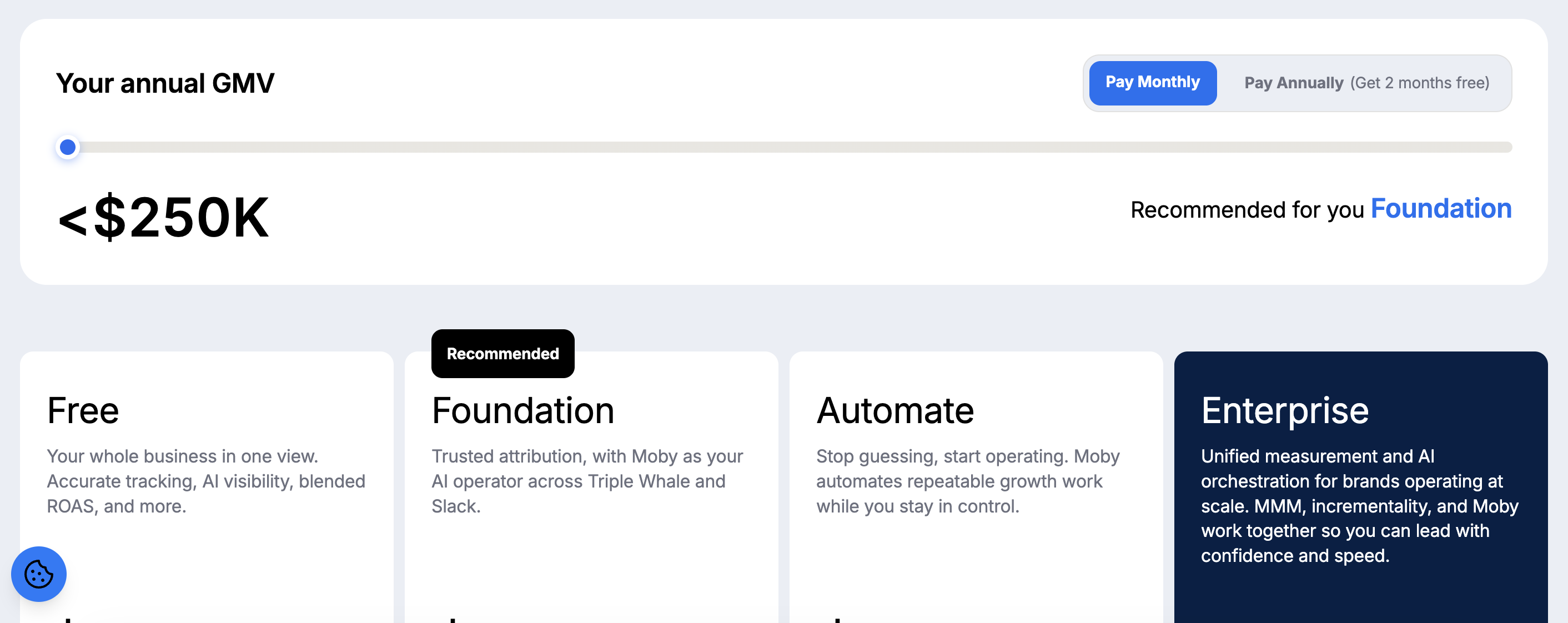
The Triple Whale free plan gives you the basics
Triple Whale offers a free plan for ecommerce brands that want a simple way to bring business metrics into one place before paying for a larger analytics or attribution setup. It is not the full Triple Whale package, but it gives smaller teams a way to test the platform without committing to a 12 month paid subscription.
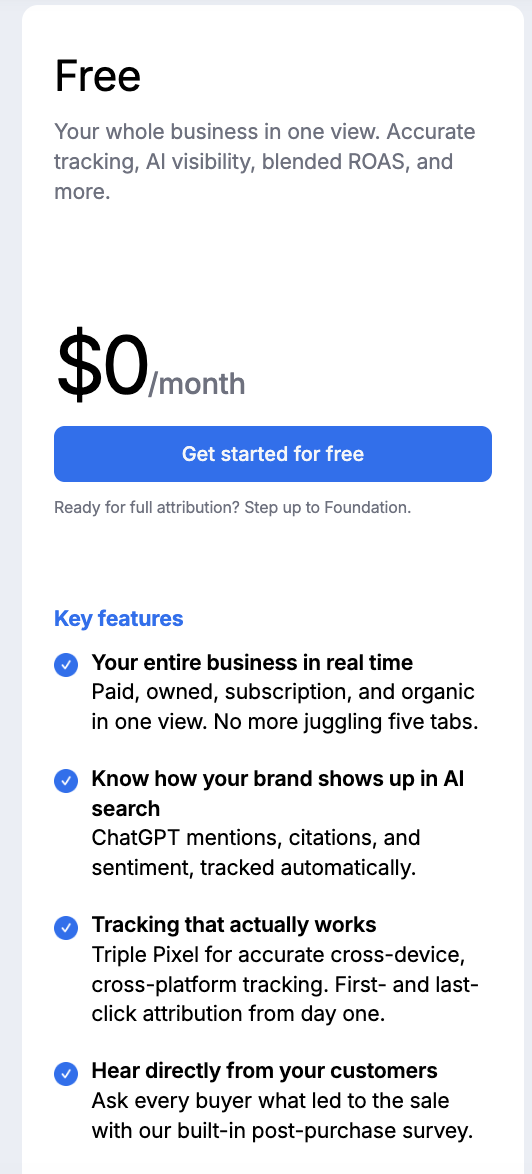
The free plan includes the core platform basics:
- 10 users
- 12 months of data storage and retention
- Real-time data refresh, updated every 15 minutes or less
- Mobile app access
- Ad platform controls
- CSV export
- Basic ecommerce reporting in the Triple Whale dashboard
This is useful if you want a central view of store performance, revenue, orders, and paid media results without immediately paying for Triple Whale’s higher plans.
For early-stage brands, the free plan can be enough to check daily performance, monitor ad spend, and get more comfortable with Triple Whale’s interface.
The main limitation is that the free plan does not give you the advanced measurement features Triple Whale is known for. Paid plans unlock deeper attribution, while Enterprise includes Compass, which brings together multi-touch attribution, marketing mix modeling, and incrementality testing in one system. Triple Whale says its Enterprise package is built for companies that need statistically defensible measurement across attribution models, MMM, and incrementality testing.
That means the free plan is best seen as a starting point, not a serious marketing attribution tool. It can help you understand basic ecommerce performance, but it is not where you get the full value of Triple Whale’s paid media measurement stack.
The free plan makes sense if:
- You are a smaller ecommerce brand that wants to test Triple Whale before paying.
- You need a basic dashboard for revenue, orders, and channel performance.
- You want mobile access to your ecommerce numbers.
- You do not need advanced attribution models yet.
- You are not ready to pay for marketing mix modeling, incrementality testing, or deeper paid media analysis.
Triple Whale’s free plan is a useful entry point, but it is also clearly built to push growing brands toward paid plans. Once you need to understand which campaigns are actually creating sales, compare attribution models, or use marketing mix modeling to guide budget decisions, the free plan will not be enough.
The Foundation plan starts at $219/month
The Foundation plan starts at $219/month and is the first serious paid Triple Whale plan for ecommerce brands that want more than a basic reporting dashboard.
Triple Whale positions it as the plan for trusted attribution, with Moby working across Triple Whale and Slack, plus deeper performance tracking for teams that need clearer answers from their data.
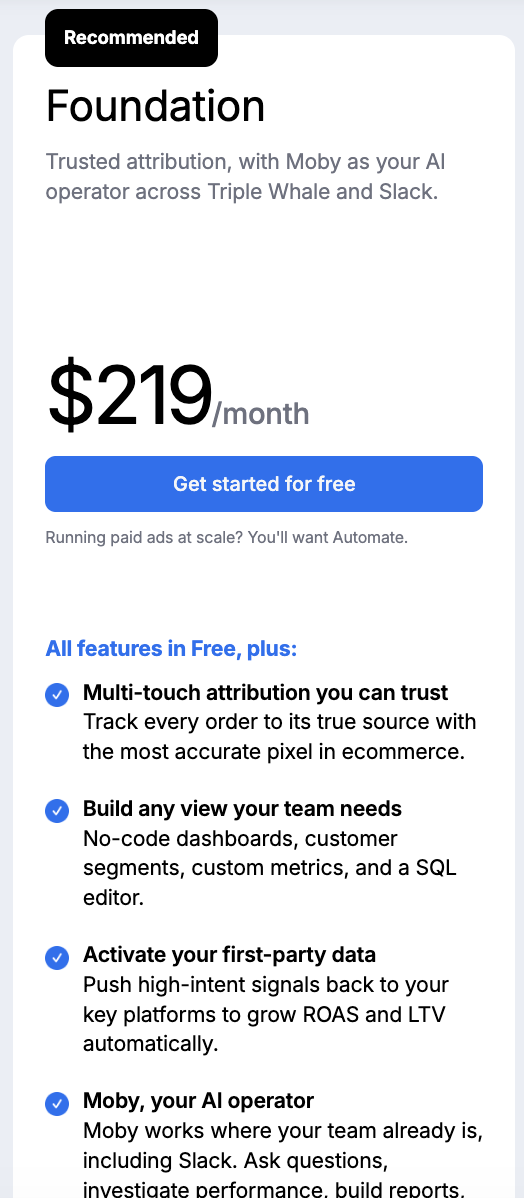
The plan includes everything in the free plan, plus:
- Multi-touch attribution through Triple Pixel
- Custom dashboards
- Customer segments
- Custom metrics
- SQL editor
- First-party data activation
- Moby for performance questions, reports, and next steps
- Slack access through Moby
- Support for connecting performance data across channels
This is where Triple Whale becomes more useful for media buyers.
The free plan gives you a general view of store performance, but Foundation adds deeper attribution and more flexible reporting. That means teams can look beyond basic channel totals and start asking which campaigns, products, audiences, and ad creatives are actually contributing to revenue.
Triple Pixel is one of the main selling points here.
Triple Whale says it tracks every order to its true source using its ecommerce pixel, which helps improve data quality when platform reporting does not tell the full story. For stores spending heavily on paid media, better attribution data can make the difference between scaling the right campaigns and putting more budget into ads that only look good inside Meta, TikTok, or Google Ads.
The business intelligence tools are also a step up from the free plan. Foundation lets teams build custom views, create customer segments, use custom metrics, and work with a SQL editor. That makes it more flexible for ecommerce operators who want to slice performance by product, channel, campaign, cohort, or customer type instead of relying only on preset dashboards. Teams that report by product can use a digital catalog maker to keep the same range in a catalog, so that product names in the reports match what customers browse.
Foundation makes sense if:
- You are running paid media and need more than first-click and last-click attribution.
- Your media buyers need cleaner data before making budget decisions.
- You want Triple Pixel tracking without moving into the more expensive plans.
- You need better data quality across ads, email, SMS, and ecommerce sales.
- You want flexible reporting that feels closer to business intelligence tools.
- You are starting to treat Triple Whale as a complete intelligence platform, not just a dashboard.
The main downside is that Foundation may still be too much for small stores that only need simple reporting.
At $219/month, it is not expensive compared to enterprise analytics tools, but it is a meaningful jump from the free plan. It makes the most sense once paid media is already important to your growth, and better attribution can help your team make better calls on spend, creative testing, and channel performance.
The Automate plan starts at $749/month
The Automate plan starts at $749/month and is built for ecommerce teams that want Triple Whale to move beyond reporting and into planning, forecasting, and decision support.
This is where the platform starts to make more sense for brands that already have meaningful paid media spend, multiple channels, and enough historical data to analyze what is actually driving profitable growth.

The Automate plan includes everything in Foundation, plus more advanced tools for measurement and planning:
- Correlation analysis
- Post-purchase survey
- Forecasting tools
- Deeper customer and campaign analysis
- More advanced reporting across paid channels
- Better support for budget allocation decisions
- Access to more historical data for performance analysis
- More automation around insights and recommendations
The biggest upgrade is that Automate helps teams understand relationships between marketing activity and revenue outcomes.
Correlation analysis can help show how changes in spend, campaign activity, creative testing, or channel mix relate to sales performance. It does not replace human judgment, but it gives marketing teams a stronger starting point before moving budget between Meta, Google, TikTok, email, SMS, and other channels.
Teams can take those findings into campaign review meetings, where Granola notetaker can capture the reasoning behind decisions to scale, pause, or test campaigns, along with the follow-up actions.
The post-purchase survey also adds another layer of conversion data. Instead of relying only on clicks, pixels, and platform reporting, brands can ask customers how they first heard about the company or what influenced their purchase.
Triple Whale says post-purchase survey data can help power its Total Impact model and give a clearer view of what influenced shopper decisions.
This matters because attribution is rarely clean.
A customer might see an ad on TikTok, search for the brand on Google, read reviews, join the email list, and buy days later. Triple Whale’s own attribution guide explains that attribution models use different lenses to understand touchpoints across the customer journey, and that brands should choose models based on goals, channel mix, and data maturity.
Automate makes the most sense if:
- Your brand spends enough on paid media that small budget allocation mistakes can become expensive.
- You want to compare campaign performance using conversion data, post-purchase survey responses, and historical data.
- Your team needs more than a dashboard to decide which channels deserve more spend.
- You are testing multiple ad creatives and need cleaner insight into what is actually influencing purchases.
- You want better forecasting before scaling campaigns.
- You need marketing insights that nontechnical operators can use without waiting on data scientists.
The downside is the price.
At $749/month, Automate is a serious jump from Foundation, and it only makes sense if the extra measurement tools help your team make better decisions often enough to justify the cost. A smaller brand that only needs basic reporting and Triple Pixel attribution may not get enough extra value from forecasting, correlation analysis, and post-purchase survey data.
But for brands spending heavily across paid media, Automate can be easier to justify. If better conversion data helps your team shift budget away from weak campaigns, invest more in winning channels, and avoid scaling the wrong ad creatives, the plan can support more profitable growth.
The Enterprise plan has custom pricing
Triple Whale’s Enterprise plan has custom pricing, so you need to talk to sales to get an exact quote. It is built for larger ecommerce brands that want Triple Whale to act as a full attribution platform, not just an analytics dashboard.
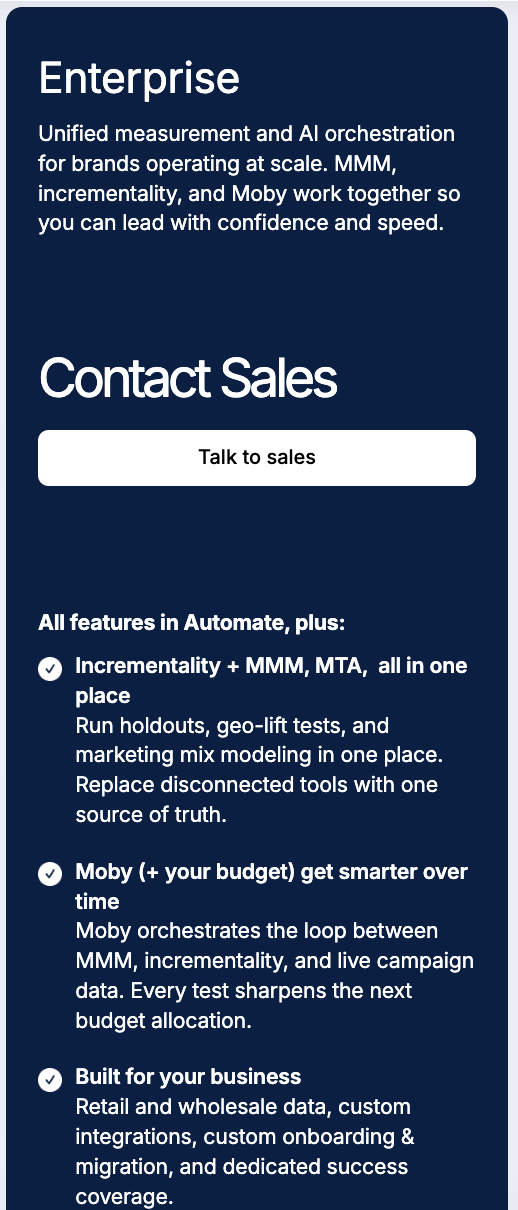
The Enterprise plan includes everything in Automate, plus:
- Dedicated customer success
- Compass access
- More advanced analytics
- Deeper measurement across marketing channels
- Better support for larger teams
- More flexible reporting and implementation support
- Access to higher-level strategic guidance
- Support for more complex ecommerce data setups
The biggest reason to consider Enterprise is Compass.
Triple Whale describes Compass as a measurement layer that brings together multi-touch attribution, marketing mix modeling, and incrementality testing. For larger brands, this can be useful because one attribution tool rarely gives the full answer on its own.
A last click report may show which campaign closed the sale.
A first-click report may show which channel introduced the buyer. Marketing mix modeling can show broader relationships between spend and revenue over time. Incrementality testing can help show which campaigns are creating demand, not just taking credit for sales that may have happened anyway.
Enterprise makes the most sense when your team needs to understand performance across the full ecommerce funnel. That includes paid search, paid social, email, SMS, organic, affiliates, influencers, and other marketing channels that all touch the same customer journey.
This plan is also better for teams that need deeper data enrichment. Larger brands often have data spread across Shopify, ad platforms, CRM tools, email platforms, analytics tools, and spreadsheets. Enterprise gives them more room to connect that data, clean it up, and turn it into reporting that different teams can actually use.
Creative analytics is another reason to consider the higher tier.
For brands spending heavily on Meta, TikTok, Google, and other channels, creative performance can make or break growth. Triple Whale’s creative analysis tools help teams understand which creative elements, messages, hooks, and formats are tied to performance, rather than judging ads only by surface-level platform metrics.
Enterprise makes sense if:
- You need an attribution platform for a large ecommerce operation.
- You are spending across several marketing channels and need more than basic reporting.
- You want to compare attribution, marketing mix modeling, and incrementality.
- You need advanced analytics for finance, marketing, creative, and leadership teams.
- You want better data enrichment across your ecommerce, ad, and customer data.
- You care about creative analytics because ad performance depends heavily on creative testing.
- You need a stronger attribution tool to support sustainable growth.
The downside is the lack of transparent pricing. Foundation and Automate have public starting prices, while Enterprise requires a sales conversation. That makes it harder to compare Triple Whale against other ecommerce attribution tools before you invest time in the buying process.
Still, Enterprise is the plan that makes the most sense for brands that already know attribution errors are expensive. If your team is spending heavily, testing many campaigns, and trying to scale without guessing, the custom price may be easier to justify. For smaller brands, it will likely be too much. For larger ecommerce teams, it gives Triple Whale the depth needed to become a serious measurement and decision-making system.
There are five add-ons available to create a complete intelligence platform
Triple Whale also sells five optional add-ons for brands that want more than the features included in their main plan. These can help turn Triple Whale from an attribution and analytics product into a more complete intelligence platform, but they also make the final price harder to compare upfront.
Triple Whale says add-ons are optional unless marked as included, and the pricing page shows some public add-on prices while others require a sales conversation.
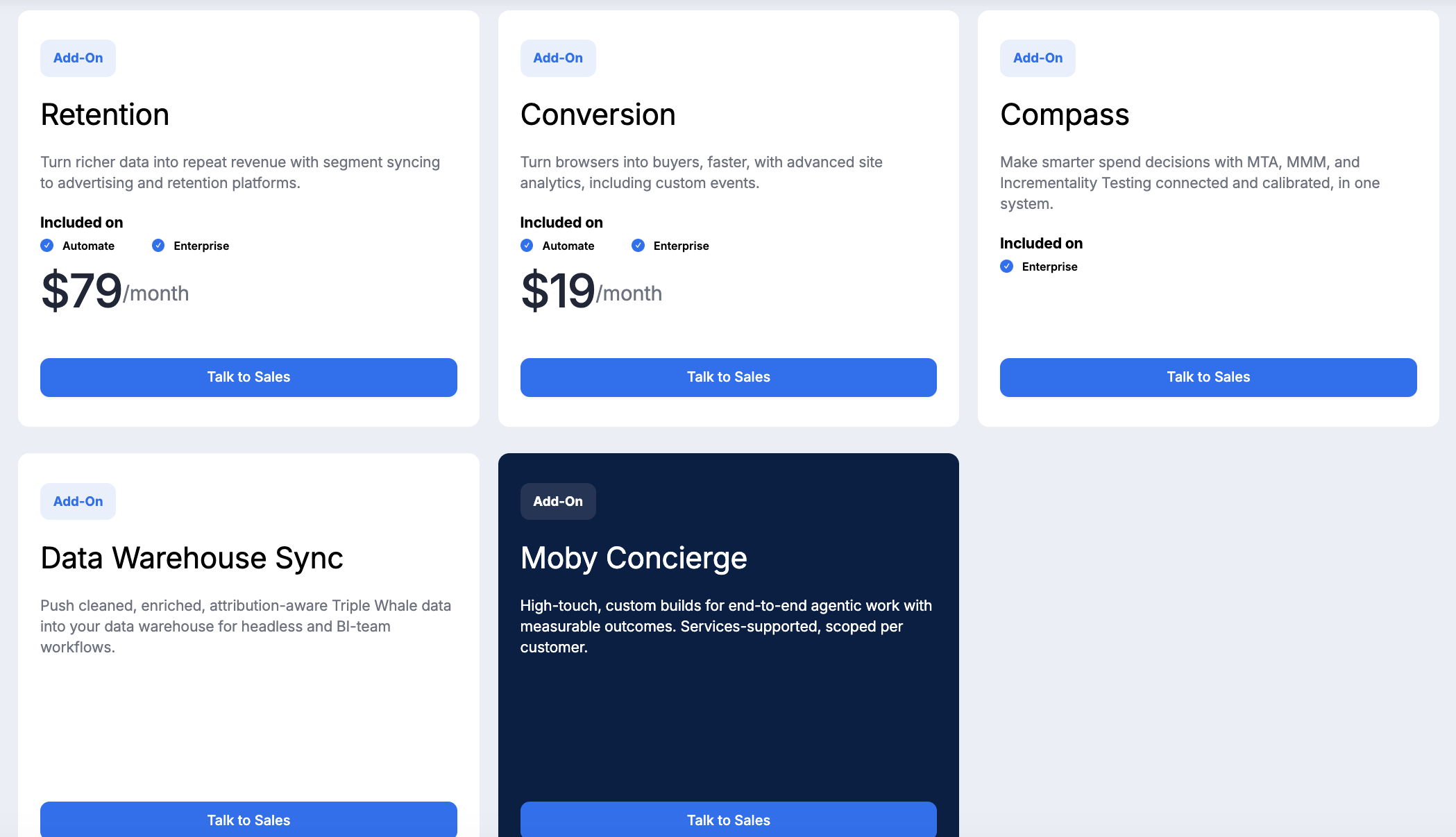
The available add-ons are:
- Retention: $19/month. Retention helps brands turn customer data into repeat purchases through segment syncing with advertising and retention platforms. It is useful if you want to retarget past buyers, exclude existing customers from acquisition campaigns, or personalize messaging based on customer behavior. Included by default on Automate and Enterprise.
- Conversion: $79/month. Conversion adds advanced site analytics, including custom events, path and funnel analysis, site search analytics, and page speed analytics. It is built for teams that want to understand how shoppers behave before checkout, where they drop off, and which parts of the site may be hurting purchases. Included by default on Automate and Enterprise.
- Compass: custom pricing. Compass is Triple Whale’s advanced measurement add on for brands that want MTA, MMM, and incrementality testing in one system. It helps teams compare different views of performance before making spend decisions, which is useful when platform reporting, last click attribution, and customer surveys all tell slightly different stories. Included by default on Enterprise.
- Data Warehouse Sync: custom pricing. Data Warehouse Sync pushes cleaned, enriched, attribution-aware Triple Whale data into your warehouse. This is mainly for brands with data teams, BI tools, or custom reporting needs that go beyond Triple Whale’s built-in dashboards. Included by default on no public plan, based on the pricing page.
- Moby Concierge: custom pricing. Moby Concierge gives brands high-touch help with custom agent builds and more advanced agentic work. It is meant for teams that want Triple Whale’s team involved in building more specific use cases, rather than only using standard Moby features inside the platform. Included by default on no public plan, based on the pricing page.
These add-ons make Triple Whale more flexible, but they also make pricing less straightforward. A brand may start with Foundation, then add Retention or Conversion. Another brand may need Automate plus Compass. Larger companies may need Enterprise, Data Warehouse Sync, and Moby Concierge if they want Triple Whale connected to their wider data stack.
Is Triple Whale worth it?
Triple Whale can be worth it for ecommerce merchants that spend heavily on paid media and need a clearer view of performance across channels. It brings data from ecommerce platforms, ad platforms, email, SMS, and other tools into one place, then helps teams turn that data into actionable insights.
The problem is that Triple Whale pricing can become expensive fast. The public plan prices are only the starting point, and the final cost can rise based on GMV, plan tier, add-ons, and the level of measurement your team needs.
Tying pricing to GMV is the biggest downside. GMV does not always reflect profit, cash flow, or how complex your reporting setup is. A store with high revenue but thin margins could end up paying more even if its business needs are fairly simple.
This creates a few problems:
- Revenue growth can trigger higher software costs. As your store grows, Triple Whale may become more expensive even if your team is using the same features.
- GMV does not equal profit. A brand doing $500,000/month in sales with low margins may have less room for expensive software than a smaller brand with stronger profit.
- Add ons can raise the real monthly price. Retention, Conversion, Compass, Data Warehouse Sync, and Moby Concierge can all increase the cost beyond the base plan.
- Advanced features may be overkill. Marketing mix modeling, incrementality testing, warehouse sync, and custom analytics are useful, but many ecommerce merchants do not need all of them.
- The plan structure can push teams upward. Once a brand needs better retention data, site analytics, or more advanced measurement, it may need a higher plan or extra add ons.
- Pricing is harder to forecast. As GMV, data needs, and add ons change, the monthly bill can become harder to predict.
The cost can spiral out of control when a brand starts with a base plan, then adds extra modules to fill gaps. A team may begin with Foundation at $219/month, move to Automate at $749/month for deeper reporting, then add custom-priced features such as Compass or Data Warehouse Sync. At that point, Triple Whale is no longer a simple attribution tool. It becomes a larger analytics investment.
This does not mean Triple Whale is a bad product.
For larger ecommerce brands, it can be a strong option because it combines attribution, reporting, forecasting, creative analysis, and broader business intelligence. If the platform helps your team shift budget away from weak campaigns and scale profitable channels, the cost may be justified.
But for smaller stores, the value is less obvious.
If you only need cleaner ad tracking, better conversion data, or basic reporting across ecommerce platforms, Triple Whale may be more than you need. The pricing model works best for brands that already have enough scale, paid media spend, and internal expertise to act on the insights.
So, is Triple Whale worth it? Yes, for larger ecommerce merchants with complex business needs and enough GMV to justify a premium analytics stack. For smaller brands, it can quickly become too expensive, especially once GMV-based pricing and add-ons start pushing the monthly cost higher.
Why wetracked.io is the better way for your Shopify store to track and manage ad spend
Triple Whale can make sense if you want a larger ecommerce analytics suite. But if your main goal is to send cleaner conversion data back into your ad platforms, wetracked.io is the better value.
The pricing is much easier to understand. wetracked.io plans are based on monthly orders, not GMV, website sessions, or tracked revenue. In other words, you do not get charged more just because your store grows in traffic or because your ad campaigns start producing more revenue.
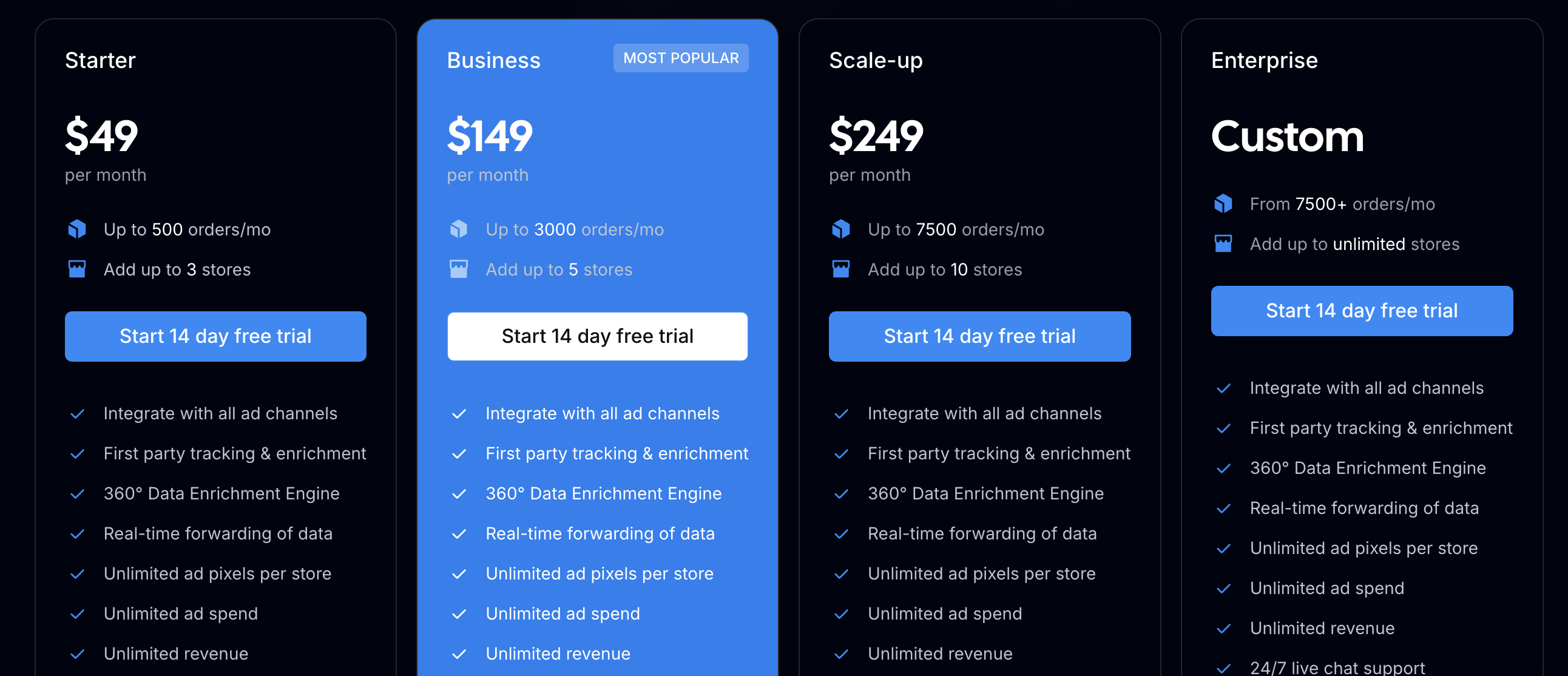
Here is how the pricing works:
- Starter: $39.20/month for up to 500 orders per month and 3 stores.
- Business: $119.20/month for up to 3,000 orders per month and 5 stores.
- Scale up: $199.20/month for up to 7,500 orders per month and 10 stores.
- Enterprise: custom pricing for more than 7,500 orders per month and unlimited stores.
That makes wetracked.io much easier to budget for.
A Shopify store can scale paid media without worrying that higher ad spend or more tracked revenue will push the monthly bill into a different category. This is a big difference from tools where the price can rise as your store gets larger, even if your tracking needs stay the same.
wetracked.io is also more focused.
It is not trying to be a full business intelligence suite, a forecasting tool, a customer retention product, and an attribution platform at the same time. Its core job is to track customers from ad click to sale, then send that data back into platforms such as Meta, Facebook, Instagram, TikTok, Snapchat, Pinterest, X, and Google Ads. Stores can connect Shopify or WooCommerce, add ad channel pixel IDs, and push sales tracking data back to ad managers.
That focus matters because most Shopify stores do not need a heavy analytics stack to improve ad performance. They need better data inside the platforms where media buying happens. wetracked.io tracks events server-side and stitches sessions together, which helps reduce data loss from ad blockers, browser restrictions, and broken pixel tracking.
For Shopify brands, this can lead to more practical day-to-day benefits:
- Better ad optimization because platforms receive stronger conversion data.
- Cleaner reporting across Meta, TikTok, Google Ads, Snapchat, Pinterest, X, and other channels.
- Less guessing when deciding which campaigns and ad creatives deserve more budget.
- More reliable purchase tracking, even when browser-based tracking misses events.
- Lower software costs compared to larger ecommerce analytics platforms.
- A 14-day free trial and a 60-day money-back guarantee, which reduces the risk of testing it.
The main reason wetracked.io is better value is simple. Triple Whale gives you a wider analytics platform, but that can also mean higher pricing, more add-ons, and features many stores may not use. wetracked.io focuses on the problem that directly affects paid media performance: making sure your ad platforms receive accurate purchase and conversion data.
For a Shopify store trying to track and manage ad spend, that is usually the smarter tradeoff. You get cleaner tracking, simpler pricing, and unlimited ad spend and revenue without paying for a larger analytics suite before you actually need one.
Try wetracked.io today, completely free.


%20(1).png)
.png)


