.png)
Rockerbox is a marketing attribution platform with no publicly available pricing. Third-party sources show that Rockerbox costs anywhere from $24,000 to $90,000 per year, which is a huge range that hides more than it reveals.
So, today we show you how much Rockerbox actually costs, based on publicly available data. We'll also show you what influences this pricing and how much you can hope to spend.
TL;DR
- Rockerbox does not publish pricing, so every customer must request a custom quote.
- Public estimates start at $24,000 per year, while Vendr reports annual contracts between $40,000 and $90,000.
- Rockerbox pricing depends on marketing spend, channel count, selected measurement products, data setup, and support requirements.
- The platform may include multi-touch attribution, marketing mix modeling, data exports, and incrementality testing, but Rockerbox does not confirm which products are bundled.
- Estimated implementation fees range from $5,000 to $20,000, bringing the potential first year total to between $29,000 and $110,000.
- Rockerbox is easier to justify for large companies with high advertising spend and complex measurement needs, but it is overpriced for many growing ecommerce brands.
- wetracked.io offers a more accessible option for Shopify and WooCommerce brands, with plans starting at $49 per month and a free 14-day trial.
Get the best Rockerbox alternative with transparent pricing. Try wetracked.io for free today.
Rockerbox pricing is not available publicly
Rockerbox has a Plans page, but it does not contain a single dollar amount. The page divides the platform into Data and Analysis products, then directs potential customers to speak with an expert for a custom quote. You can see which parts of the platform handle marketing data and which cover measurement, but there is no starting price or standard subscription fee.
This is one of the most common reasons why businesses look at Rockerbox alternatives, too.
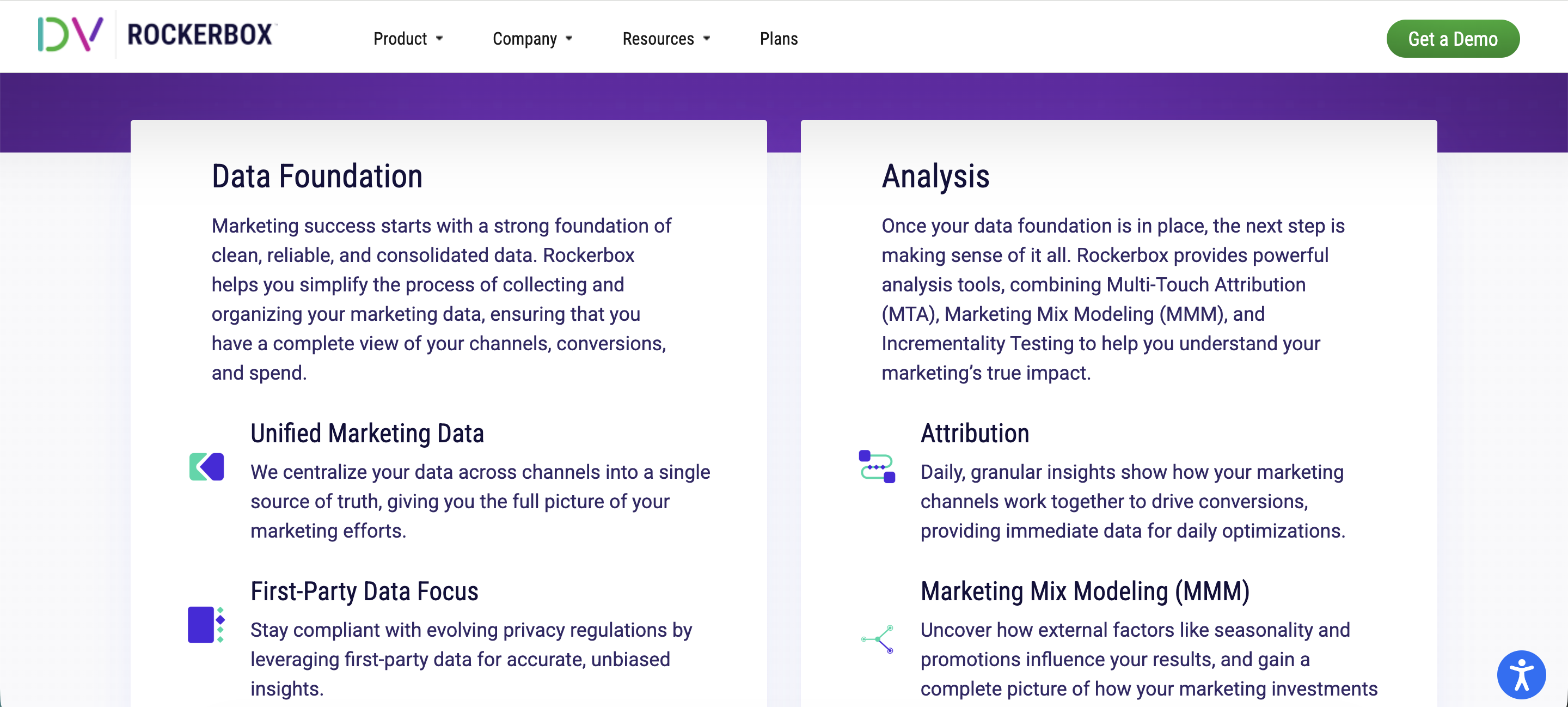
This means buyers cannot estimate their costs based on the number of marketing channels they use or the measurement methods they need. Rockerbox offers marketing mix modeling alongside multi-touch attribution, but it does not explain whether these tools are included together or priced separately.
The only specific numbers come from third-party software directories and purchasing data.
Capterra lists Rockerbox Basic at $2,000 per feature, per month. Software Advice shows the same $2,000 monthly starting price, while also stating that final pricing is available on request. This gives us the lowest public estimate of $24,000 per year, assuming the information is current and the customer only pays for one feature.
Vendr reports considerably higher figures. According to its Rockerbox pricing data, a typical mid-market contract costs between $40,000 and $90,000 per year for companies spending between $100,000 and $500,000 per month on marketing. Vendr says the final quote can depend on marketing spend, channel complexity, and the required service level.
None of these figures have been confirmed by Rockerbox. The safest conclusion is that pricing may start at around $24,000 per year, while larger customers can expect annual contracts closer to $40,000 to $90,000.
What is included in Rockerbox pricing?
Rockerbox does not sell one clearly defined package with a fixed feature list. Its Plans page divides the platform into Data and Analysis products, then allows each company to select a combination based on its measurement needs. This means your quote may include only part of the platform rather than every Rockerbox product.
Marketing data collection
Rockerbox Collect brings marketing spend and performance data from different platforms into one standardized dataset. This can include impressions, clicks, conversions, revenue, and other campaign metrics.
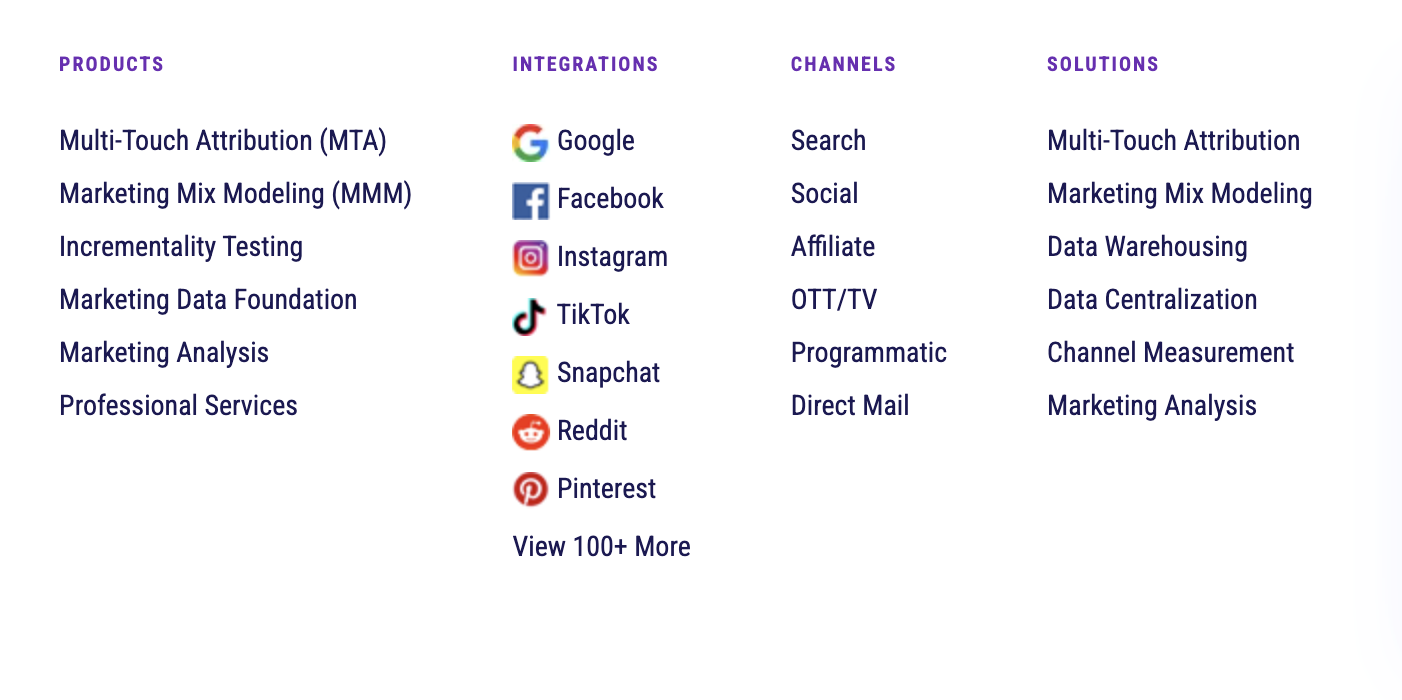
Rockerbox Track adds first-party customer activity, including the touchpoints that led to each conversion. This attribution data gives marketing teams a clearer view of how customers interact with campaigns across different channels.
Data exports
Rockerbox Export lets companies send their unified marketing data to Google Sheets or a data warehouse. The platform supports systems such as Snowflake, Google BigQuery, and Amazon Redshift, allowing internal analysts to use Rockerbox data in their existing reporting tools.
It is unclear whether unlimited exports are included in every quote. Buyers should confirm which destinations are supported, how frequently data is updated, and whether custom pipelines come with an additional fee.
Multi-touch attribution
Rockerbox Journey provides multi-touch attribution across the customer journey. It connects marketing touchpoints with conversions, assigns credit through customizable attribution models, and shows how different channels overlap.
These reports provide more detailed information than basic marketing attribution tools that only show the first or final interaction. Teams can examine complete conversion paths and compare channel performance when making daily campaign decisions.
Marketing mix modeling
Rockerbox also offers marketing mix modeling, which uses historical spend and revenue data to estimate how different channels affect business performance. Its attribution marketing mix modeling capabilities are designed to give companies both user-level reporting and a broader view of long-term channel performance.
The MMM product includes scenario planning, channel spending recommendations, and a media planner. Teams can use these features to test different budgets, forecast expected revenue, and improve budget allocation across channels.
Incrementality testing
Rockerbox Testing measures whether campaigns produced additional conversions or whether those conversions would have happened without the advertising. Rockerbox describes this as a managed product, suggesting that the service may include support from its measurement team rather than only access to software.
What buyers need to confirm
Rockerbox does not explain whether Collect, Track, Export, Journey, MMM, and Testing are bundled together. Its Plans page says customers select their own mix of products, so the features included will depend on the final quote.
Before signing a contract, you should ask which products are included, what data limits apply, and whether implementation or managed testing is charged separately. Without these details, two Rockerbox customers could pay similar annual fees while receiving very different levels of access.
Rockerbox implementation costs
Rockerbox does not publish an official implementation fee. Vendr states that Rockerbox typically charges a one-time onboarding fee for platform setup, data integration, pixel deployment, and initial configuration. Another pricing analysis based on Vendr contract data places this fee between $5,000 and $20,000, although Rockerbox has not confirmed that range.
This could bring the estimated first-year cost to between $29,000 and $110,000. The lower figure combines the $24,000 annual starting estimate with a $5,000 setup fee. The upper figure combines a $90,000 subscription with a $20,000 implementation charge.
What does Rockerbox implementation include?
Rockerbox onboarding covers conversion tracking, marketing tracking, advertising account connections, spend collection, and quality checks. Conversion tracking may involve a Shopify integration, Google Tag Manager pixels, webhooks, or scheduled file deliveries. Rockerbox then checks whether conversion and campaign data are being collected correctly before the customer starts using it for marketing analysis.
The process normally takes between six and eight weeks for multi-touch attribution. Rockerbox says the exact timeline depends on the complexity of the setup and how quickly the customer provides access to its platforms and data. Testing can begin in one or two weeks, while marketing mix modeling may also require six to eight weeks once the required data is ready.
Implementation can take longer when a company runs marketing campaigns across numerous advertising platforms or tracks conversions through several systems. Offline conversions, direct mail, custom vendors, batch files, and data warehouse connections can all add work to the setup. Each source must use consistent campaign and conversion information before Rockerbox can produce dependable reports.
What can raise the implementation fee?
The upper end of the estimated range is more likely for companies that need custom integrations or advanced attribution modeling.
Rockerbox may need to connect several customer identifiers, import historical records, configure custom conversion events, and create rules for how campaigns are classified.
Attribution accuracy depends heavily on the quality of this initial setup. Missing campaign parameters or inconsistent conversion records can affect how Rockerbox assigns credit. Buyers with complicated data systems may therefore need more technical sessions or outside developer support before their reports are ready.
Rockerbox includes up to five hours of technical implementation sessions with standard support and up to ten hours with premium support. Premium support uses custom pricing, while additional professional services for analysis and reporting are not included in the standard support package.
Before accepting a quote, buyers should ask whether the implementation fee is fixed and which integrations are covered. They should also confirm whether historical data imports, custom tracking work, advanced attribution modeling, and support after launch are included or charged separately.
Factors that influence Rockerbox pricing
Rockerbox does not explain how it calculates each quote, so the factors below are based on the product structure and the way attribution platforms are commonly priced. In practice, the total cost will depend on how much data Rockerbox needs to process, which measurement products you select, and how much support your team requires.
Your monthly marketing spend
Marketing spend is likely one of the biggest pricing factors. Vendr reports higher contract values for companies spending between $100,000 and $500,000 per month, which suggests that larger advertising budgets can lead to higher Rockerbox fees.
This makes sense because higher spend usually means more campaigns and more conversion data to process. A company running a small number of paid campaigns will have simpler reporting needs than a brand tracking activity across dozens of marketing channels.
Rockerbox may also use monthly spend as a rough indicator of company size and platform value. Two customers could use similar attribution models, yet receive different quotes because one manages a much larger advertising budget.
The number of marketing channels you track
Your quote may also depend on how many sources Rockerbox needs to connect. Standard digital sources such as Meta Ads and Google Ads may be easier to set up than a measurement program that also includes direct mail and offline channels.
Each additional source creates more work around data collection and matching. Rockerbox needs to connect ad spend with customer data, purchases, and other events before it can show how each channel contributes to the customer journey.
Pricing may therefore rise when a company wants one view across paid social, search, retail media, television, and direct mail. The final cost can also depend on whether Rockerbox already supports those sources or needs a custom integration.
The measurement products you choose
Rockerbox offers several ways to analyze marketing performance. These include multi-touch attribution, media mix modeling, testing tools, and audience analysis. Rockerbox does not say whether every product is included in one subscription or added separately.
A company using only attribution reporting may receive a lower quote than one combining several measurement methods. Media mix modeling usually requires a large amount of historical marketing data, while attribution models rely more heavily on event-level conversion data.
Using both methods can give teams a broader view of performance, but it may also raise the subscription price. This could partly explain why public estimates range from $24,000 to $90,000 per year.
Your data setup and integration requirements
The location and condition of your data can influence how difficult Rockerbox is to implement. Some companies may send data directly from advertising platforms and ecommerce tools. Others may need Rockerbox to connect with a data warehouse and combine information from several internal systems.
The quote may be higher when the implementation involves custom data pipelines or complex identity matching. Rockerbox needs the same data definitions across each source before it can produce reliable reporting.
For example, customer data from a CRM may use different identifiers from conversion data stored in an ecommerce platform. Connecting those records takes more work than importing data from a standard integration.
This can affect both the initial implementation fee and the ongoing subscription cost. Vendr reports potential setup fees between $5,000 and $20,000, although Rockerbox does not confirm these figures publicly.
Your customer journey and attribution complexity
Companies with longer customer journeys may need a more advanced Rockerbox setup. A direct-to-consumer brand with quick online purchases has a simpler measurement problem than a company where customers interact with several campaigns before converting.
The complexity increases further when online activity must be connected with offline channels. Rockerbox may need to link website visits, customer data, direct mail exposure, and in-store purchases to understand the full customer journey.
Different attribution models can also require different levels of configuration and analysis. A basic last-touch report is easier to produce than a model that assigns credit across several interactions.
This means Rockerbox pricing may reflect more than data volume alone. The company may also consider how difficult it is to connect each interaction and turn the same data into useful reporting across several measurement methods.
The amount of support you need
Support and service requirements can also change the final quote. Some companies may only need help during onboarding, while others may want regular strategy calls and ongoing analysis.
A business with an experienced analytics team may be able to manage most reporting internally. A smaller team may depend more heavily on Rockerbox for setup, data validation, and interpretation.
This is another reason two companies using similar features may pay different prices. Rockerbox sells a measurement service as well as software, so the level of involvement required from its team may be reflected in the contract.
Is Rockerbox worth the price?
For most companies, Rockerbox is difficult to justify at an estimated annual cost of $40,000 to $90,000, especially once implementation fees are added. The platform can provide accurate attribution across digital channels, but the price places it well beyond what many growing brands need to spend on measurement.
Rockerbox is most defensible for large companies running campaigns across many ad platforms, with enough internal analytics resources to act on the findings. These teams may benefit from combining multi touch attribution marketing mix measurement with incrementality testing and centralized campaign data.
The problem is that many advertisers do not need the full product suite. A company that mainly runs campaigns through Meta, Google, and a few other digital channels may need reliable tracking and reporting, rather than several enterprise measurement methods bundled into a custom contract.
Rockerbox also uses custom enterprise pricing, which makes it difficult to judge value before speaking with sales. Buyers cannot see which features are included at each price level, how usage affects the quote, or whether specific products require separate fees. A platform can produce valuable insights and still be a poor purchasing decision when its cost structure is difficult to evaluate.
There is also a point where advanced measurement adds less practical value than expected. Marketing teams still need clean tracking, consistent campaign naming, and enough conversion volume for the results to be useful. Expensive software cannot compensate for weak data or basic attribution logic that has not been configured correctly.
Rockerbox may be worth the price for enterprises spending several million dollars per year on advertising, particularly when small improvements in budget allocation could cover the platform cost. For smaller and mid-sized brands, however, the price is likely too high. More accessible marketing attribution tools can deliver the reporting most teams need without a large implementation charge or an annual contract approaching six figures.
Get the better Rockerbox alternative for ad tracking
Rockerbox offers a broad analytics platform, but most ecommerce brands do not need to spend tens of thousands of dollars per year to understand which ads generate sales. They need dependable conversion tracking, clear pricing, and data their ad platforms can actually use.
wetracked.io focuses on that narrower problem.
It captures customer events, connects each sale to its originating ad, and sends enriched conversion data back to platforms such as Meta, Google, TikTok, and Snapchat. Our cross-channel attribution gives ecommerce teams a single view of paid advertising performance without requiring a lengthy enterprise implementation.
The difference is scope. wetracked.io is not intended to replace Rockerbox for companies that need marketing mix modeling, incrementality testing, or detailed analysis of offline activity. It also does not claim to map the entire customer journey across every possible business system.
Our attribution capabilities are built for Shopify and WooCommerce brands that primarily need to follow customers from ad click to purchase and return accurate data to their advertising accounts.
For that use case, wetracked.io has a much easier pricing model.
Monthly plans start at $49 for up to 500 orders, while the Business plan costs $149 for up to 3,000 orders. Every listed plan includes all ad channel integrations, first-party tracking, unlimited ad spend, and real-time data forwarding.
Instead of requesting a custom quote and paying a separate implementation fee, you can connect your store without coding and start testing the software immediately.
Try wetracked.io free for 14 days and see how much of your advertising performance has been missing from your current reports.


%20(1).png)
.png)


