.png)
Marketing attribution used to be simple. Someone clicked an ad, bought a product, and the platform assigns credit.
That version of the internet barely exists anymore.
Today, customers bounce between TikTok ads, Google searches, email campaigns, influencer content, YouTube videos, branded searches, and direct visits before they finally convert. Meanwhile, every platform claims it drove the sale. Meta says one thing. Google says another. Shopify tells a different story entirely.
That is why attribution software has become one of the most important parts of a modern marketing stack.
The right attribution platform helps you understand what is actually influencing revenue, not just what happened right before the purchase. Some tools specialize in ecommerce attribution. Others focus on B2B pipeline tracking, affiliate marketing, offline conversions, or call attribution.
In this guide, we break down the best marketing attribution tools in 2026, including what each platform does best, where it struggles, and which type of business it actually makes sense for.
TL;DR
- wetracked.io: best for ecommerce brands that want cleaner attribution and profitability reporting across paid channels
- Cometly: best for multi-touch attribution with strong server-side tracking capabilities
- Google Analytics: best free starting point for broad cross-channel attribution reporting
- Hyros: best for high spend advertisers needing more reliable revenue attribution across ad platforms
- HockeyStack: best for B2B revenue attribution and long multi-stakeholder sales cycles
- Affise: best for affiliate and partner attribution across large performance marketing programs
- Triple Whale: best for Shopify brands tracking attribution and profitability in one dashboard
- Attribution App: best for businesses connecting attribution data directly to CRM and sales funnel performance
- Adbeacon: best for improving attribution accuracy with server-side conversion tracking
- Matomo: best for privacy-focused attribution and first-party analytics ownership
- Adobe Analytics: best for enterprise-level attribution across massive customer datasets
- Ruler Analytics: best for B2B lead attribution tied directly to pipeline and revenue
- CallRail: best for offline attribution and phone call tracking for lead generation businesses
Top features to look for in marketing attribution software
Not all attribution platforms solve the same problem. Some are built for ecommerce brands trying to understand paid ads, while others focus on B2B pipelines, phone call attribution, or enterprise analytics. That is why choosing the right marketing attribution tool starts with understanding what kind of customer journey you actually need to track.
One of the most important features is multi-touch attribution. Most attribution tools no longer rely only on last click reporting because modern customer journeys rarely happen in a straight line. Good platforms should show how different campaigns, channels, and touchpoints contribute to conversions over time.
Another important feature is cross-channel reporting. Your attribution software should combine data from Meta, Google, email platforms, ecommerce systems, CRMs, and other marketing tools into one place. Otherwise, you are still stuck comparing disconnected dashboards manually.
For businesses handling calls, retail activity, or sales teams, support for online and offline channels also matters. Some attribution platforms can connect phone calls, booked meetings, and offline conversions back to marketing campaigns, which gives a much more complete picture of ROI.
You should also pay attention to tracking accuracy. Browser restrictions, ad blockers, and privacy changes have made attribution harder over the past few years. Platforms using server-side tracking and first-party data collection usually provide more reliable reporting.
Finally, look at usability. Some tools are built for analysts, while others focus on helping marketers quickly analyze performance and make decisions without spending hours building reports.
The best marketing attribution tools to get actionable insights in 2026 and beyond
If you want to find out where your marketing dollars are actually going, you need a strong tech stack focused on the exact type of campaigns you're running for yourself or your clients. For teams building a broader AI-powered marketing stack, attribution tools can work alongside AI platforms for content, automation, research, and campaign execution. Here are some of your best options in 2026.
1. wetracked.io

Wetracked.io is a marketing attribution and reporting platform built for ecommerce brands that want a clearer understanding of what actually drives sales. It focuses heavily on attribution accuracy, profitability tracking, and simplifying cross-channel reporting so teams can make faster, data-driven decision-making without digging through disconnected dashboards.
Unlike many attribution tools that feel overly technical or built only for analysts, wetracked.io puts a strong emphasis on usability. It works especially well for brands running paid acquisition campaigns across Meta, Google, TikTok, and other channels that need cleaner attribution data and easier ways to analyze performance.
Key features
- Multi-touch attribution - Tracks how different campaigns, channels, and touchpoints contribute to conversions and revenue.
- Cross-channel reporting - Combines advertising, ecommerce, and marketing data into centralized attribution dashboards.
- Profitability tracking - Connects ad spend directly to revenue, margins, ROAS, and customer acquisition performance.
- Creative performance analysis - Helps teams identify which ads, creatives, and formats actually drive purchases.
- Customer journey visibility - Shows how shoppers move from first interaction to final conversion across channels.
- Real-time attribution dashboards - Gives marketers up-to-date visibility into campaign performance and revenue trends.
- Custom reporting views - Lets businesses create dashboards around the KPIs most important to their growth goals.
- Performance monitoring alerts - Helps teams quickly react to drops, spikes, or unusual campaign activity.
- Ecommerce platform integrations - Connects with stores and advertising platforms to improve attribution accuracy and reporting depth.
- Simplified analytics workflows - Makes it easier for operators and marketers to get valuable insights without relying on overly complicated BI tools.
wetracked.io is strongest for e-commerce-focused attribution and paid acquisition analysis. Businesses needing highly customized enterprise warehouse reporting or complex offline attribution workflows may still require additional analytics infrastructure.
The platform also delivers the most value when brands actively invest in paid advertising across several channels. Smaller businesses with limited traffic or minimal ad spend may not fully use all of the attribution capabilities.
2. Cometly
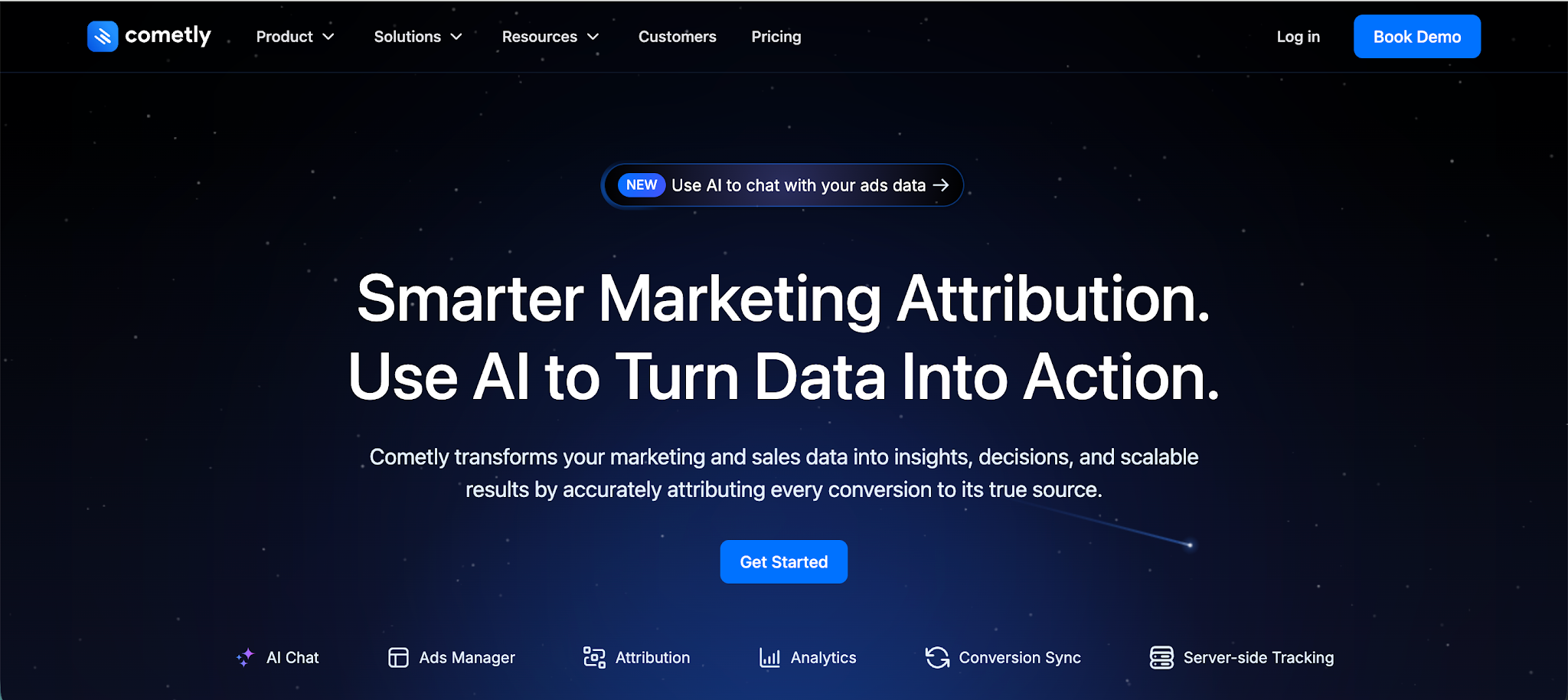
Cometly is a marketing attribution platform built for advertisers that need clearer visibility into what actually drives revenue across paid and organic channels. It is especially strong at multi-touch attribution, making it a good fit for ecommerce brands and performance marketers frustrated with inflated platform reporting and inconsistent conversion data.
Key features
- Multi-touch attribution - Tracks the full customer journey across ads, email, organic traffic, referrals, and direct visits instead of relying only on last click attribution.
- Server-side tracking - Uses server-side event tracking to improve attribution accuracy even with ad blockers, browser restrictions, and cookie limitations.
- Attribution model comparison - Lets marketers compare first click, last click, linear, and custom attribution models to see how revenue credit shifts between channels.
- Revenue-focused reporting - Connects ad spend directly to conversions, revenue, customer lifetime value, and ROAS across campaigns.
- AI-powered campaign insights - Highlights your top-performing ads, audiences, and channels using AI-driven recommendations and performance analysis.
Cometly works particularly well for businesses spending heavily across multiple paid channels. Its biggest strength is helping marketers understand assisted conversions and the real impact of campaigns that often get ignored in platform-specific reporting. Once you finish signing a deal using a Docusign alternative like Esign, you'll want to track your ad spend accurately and this is where Cometly comes in.
The downside is that setup can take some effort, especially if you want clean server-side tracking and CRM integrations. Smaller businesses with simple ad setups may also find the platform more advanced than they actually need.
3. Google Analytics
Google Analytics 4 is Google’s analytics platform for tracking website traffic, user behavior, conversions, and marketing performance across websites and apps. It is one of the most widely used attribution tools because it gives businesses a central place to connect attribution data, marketing data, and customer behavior in one reporting environment.
Key features
- Cross channel attribution reports - Tracks how different channels contribute to conversions across paid, organic, referral, and direct traffic.
- Data driven attribution - Uses Google’s machine learning models to distribute conversion credit across multiple touchpoints instead of relying only on last click reporting.
- Customer journey analysis - Helps marketers understand how users move through websites before converting.
- Google Ads integration - Connects campaign data directly with conversions, revenue, and audience behavior inside Google Analytics.
- Custom event tracking - Lets businesses track specific user actions and generate actionable insights around engagement and conversions.
GA4 is often the default starting point for attribution reporting, but it has clear limitations. Attribution accuracy depends heavily on proper setup, event tracking, and tagging, which means many businesses end up working with incomplete or messy data.
The interface can also feel overly technical, especially for teams that just want straightforward answers around revenue attribution. While GA4 is useful for broad attribution analysis, it is usually not enough on its own for businesses needing highly accurate ecommerce attribution or deeper profitability reporting.
4. Hyros

Hyros is an attribution platform built for businesses spending serious money on paid advertising and needing more reliable conversion tracking across channels. It is especially strong at tying revenue back to specific campaigns, which makes it popular with ecommerce brands, info product companies, and agencies managing large ad budgets across multiple ad platforms.
Key features
- Multi-touch attribution - Tracks the entire customer journey across ads, email, organic traffic, and direct visits instead of relying on platform-reported conversions alone.
- Advanced conversion tracking - Uses first-party data and tracking methods designed to improve attribution accuracy despite browser and privacy limitations.
- Revenue attribution dashboards - Connects campaigns directly to sales, ROAS, customer value, and profitability metrics.
- Cross-platform reporting - Combines attribution data from Meta, Google, TikTok, YouTube, and other ad platforms into one view.
- Marketing performance analysis - Helps marketers compare channels, campaigns, and marketing efforts to identify what actually drives revenue.
Hyros is particularly useful for businesses that feel platform reporting is overstating results or double-counting conversions. It does a strong job of showing assisted conversions and helping advertisers understand which channels influence purchases, not just which one got the final click.
The tradeoff is complexity. Proper setup can take time, and businesses without technical support may struggle with implementation. It is also not a lightweight reporting tool, so smaller advertisers with modest budgets may not get enough value from it. Businesses looking for broader forecasting or marketing mix modelling (MMM) may still need additional analytics tools alongside Hyros.
5. HockeyStack

HockeyStack is a revenue attribution and analytics platform built primarily for B2B companies with long and complex sales cycles. It stands out because of how deeply it analyzes marketing touchpoints across the full funnel, making it especially useful for teams that care more about pipeline and revenue attribution than simple lead reporting.
Key features
- Multi-touch attribution - Supports several attribution models and helps teams understand how channels, campaigns, ads, and content influence pipeline and revenue across the full funnel.
- Buyer journey analysis - Visualizes the entire customer journey from first visit to closed deal, including anonymous touchpoints and account level activity.
- Marketing mix modeling and lift analysis - Goes beyond standard attribution by measuring incrementality and channel lift instead of relying only on correlation based reporting.
- Self-reported attribution tracking - Combines qualitative attribution responses with tracked behavioral data to generate deeper attribution insights.
- No code reporting and dashboards - Lets revenue and marketing teams build custom reports around pipeline influence, campaigns, content, and marketing touchpoints without technical setup.
HockeyStack is particularly strong for B2B attribution because it handles long sales cycles and multi-stakeholder buying journeys much better than most traditional analytics tools. It also does a better job than many competitors at connecting attribution directly to pipeline and closed revenue instead of only top-of-funnel conversions.
The downside is that it can feel overwhelming for smaller teams or ecommerce brands that just want simple attribution dashboards. Proper implementation also takes time because the platform becomes most valuable when deeply connected with CRMs, ad platforms, and sales systems.
6. Affise

Affise is a partnership and affiliate attribution platform built for companies running large-scale performance marketing programs. It is especially strong at tracking partner-driven conversions across multiple channels, which makes it popular with affiliate networks, mobile apps, and brands managing complex partner ecosystems.
Key features
- Affiliate attribution tracking - Tracks clicks, conversions, payouts, and partner performance across affiliate and referral campaigns.
- Multi-channel attribution - Helps businesses measure conversions coming from influencers, affiliates, paid ads, and other marketing channels.
- Custom attribution rules - Lets teams configure a marketing attribution model based on their own conversion logic and partner structure.
- Fraud prevention tools - Detects suspicious traffic, fake conversions, and click fraud across campaigns.
- Partner management dashboards - Gives advertisers visibility into publisher performance, campaign profitability, and conversion quality.
Affise is highly specialized for affiliate and partner attribution rather than broader ecommerce or marketing analytics. Businesses mainly focused on paid social or standard ecommerce attribution may find the platform too partner-centric for their needs.
The setup process can also be fairly technical, especially for companies managing large affiliate programs across multiple channels. Smaller brands without dedicated affiliate operations may end up paying for functionality they rarely use.
7. Triple Whale

Triple Whale is an ecommerce attribution and analytics platform built mainly for Shopify brands running paid advertising across Meta, Google, TikTok, and other channels. It is especially strong at helping ecommerce teams understand how different marketing channels contribute to revenue, even when platform attribution numbers do not match up.
Key features
- Multi touch attribution - Tracks how shoppers interact with ads and campaigns before purchasing instead of relying only on last click reporting.
- Marketing performance dashboards - Combines ad spend, revenue, ROAS, customer value, and store performance into centralized reporting views.
- Creative and campaign analysis - Helps marketers compare ad campaigns, creatives, audiences, and acquisition channels side by side.
- Customer lifetime value tracking - Connects attribution data with repeat purchases and long term customer revenue.
- Shopify focused integrations - Pulls ecommerce and advertising data directly into one dashboard for easier attribution analysis.
Triple Whale works particularly well for ecommerce brands spending heavily on paid acquisition. Its main strength is simplifying attribution and profitability reporting for operators who do not want to spend hours stitching data together manually.
The downside is that the platform is heavily ecommerce-focused, especially around Shopify. Businesses outside ecommerce or companies needing advanced B2B attribution workflows may find it too specialized. Pricing can also become expensive for smaller stores with lower ad spend, which is why many marketers look at Triple Whale alternatives.
8. Attribution App

Attribution App is a multi-touch attribution platform designed to help businesses connect marketing activity directly to revenue and pipeline performance. It is especially useful for companies running campaigns across multiple platforms that want a clearer picture of how leads move through the marketing and sales funnel before converting.
Key features
- Multi-touch attribution tracking - Supports first click, last click, linear, time decay, and other multi-touch attribution models.
- Cross-channel reporting - Combines attribution data from paid ads, email, organic traffic, referrals, and CRM systems into one view.
- Revenue attribution dashboards - Connects campaigns directly to leads, sales, customer acquisition costs, and revenue outcomes.
- CRM integrations - Syncs with platforms like HubSpot and Salesforce to track attribution deeper into the sales process.
- Marketing funnel analysis - Helps teams understand how campaigns influence movement through different funnel stages and overall marketing strategy.
Attribution App does a good job balancing usability and advanced attribution analysis, especially for companies needing clearer reporting beyond platform-specific dashboards. It is particularly helpful for businesses with longer buying cycles where several channels influence conversions before a sale happens.
The downside is that setup can still take time, especially when connecting multiple platforms and CRM systems. Smaller businesses with very simple funnels may also find the platform more advanced than they realistically need.
9. Adbeacon

Adbeacon is a marketing attribution platform focused on helping advertisers track conversions and revenue more accurately across paid channels. It is especially popular with ecommerce brands and performance marketers that want cleaner attribution data than what they get directly from advertising platforms.
Key features
- Multi-touch attribution - Uses advanced attribution models to track how different ads and touchpoints contribute to conversions and revenue.
- Server-side tracking - Improves attribution accuracy by reducing data loss caused by browser restrictions and ad blockers.
- Cross-platform attribution - Combines reporting from Meta, Google, TikTok, and other advertising platforms into one dashboard.
- Revenue-focused reporting - Connects marketing campaigns directly to purchases, ROAS, customer value, and profitability metrics.
- Conversion tracking dashboards - Gives advertisers accurate data around campaign performance, assisted conversions, and customer acquisition.
Adbeacon works particularly well for businesses struggling with inconsistent reporting between ad platforms and ecommerce stores. Its biggest strength is simplifying attribution and showing where conversions and revenue are actually coming from instead of relying entirely on platform-reported numbers.
The downside is that implementation still requires some setup work, especially if businesses want advanced server side tracking and custom attribution configurations. Smaller advertisers with simple campaign structures may also find the platform more advanced than necessary.
10. Matomo

Matomo is a privacy-focused analytics and attribution platform that gives businesses full ownership over their tracking data. It is especially useful for companies that care about data accuracy, compliance, and controlling how attribution data is collected across digital and offline channels.
Key features
- Multi-channel attribution - Tracks how different campaigns and traffic sources contribute to conversions across websites and apps.
- First-party analytics tracking - Uses first-party data collection to improve attribution reliability and reduce dependence on third-party cookies.
- Custom attribution reports - Lets businesses build attribution views around conversions, revenue data, and campaign performance.
- Offline and online tracking support - Helps teams combine digital and offline channels into broader attribution reporting workflows.
- Self-hosted deployment options - Gives organizations full control over data storage, privacy settings, and analytics infrastructure.
Matomo stands out because of its privacy and ownership approach. Businesses operating in regulated industries or regions with strict compliance requirements often prefer it over cloud-based analytics platforms that rely heavily on external data processing.
The tradeoff is usability. Matomo can feel more technical than mainstream attribution tools, especially for teams wanting polished dashboards and fast setup. While it handles analytics and attribution well, businesses looking for highly advanced advertising attribution or automated media optimization may still need additional tools.
11. Adobe Analytics

Adobe Analytics is an enterprise analytics and attribution platform built for large companies managing massive amounts of customer and marketing data. It is especially strong at accurate attribution across complex customer journeys, which makes it popular with enterprise ecommerce brands, media companies, and organizations running large paid media campaigns.
Key features
- Advanced attribution models - Supports customizable attribution logic across channels, campaigns, and touchpoints.
- Cross-channel journey analysis - Tracks how users move between websites, apps, email, ads, and other marketing interactions.
- Real-time reporting dashboards - Gives teams visibility into conversions, revenue, engagement, and other key metrics as data comes in.
- User-level analytics - Helps businesses analyze behavior patterns, audience segments, and conversion paths using detailed user-level data.
- Predictive analytics and AI insights - Uses machine learning to identify trends, forecast performance, and improve budget allocation decisions.
Adobe Analytics does a very strong job with enterprise attribution because it can process huge datasets and highly customized reporting structures. Businesses with complicated funnels and multiple brands often use it to unify attribution reporting across departments and regions.
The downside is complexity. Setup, implementation, and maintenance usually require dedicated analysts or technical teams, which makes the platform difficult for smaller businesses to justify. It is also one of the more expensive analytics tools on the market, especially compared to simpler attribution-focused platforms.
12. Ruler Analytics

Ruler Analytics is a marketing attribution platform focused on connecting marketing activity directly to revenue and pipeline outcomes. Ruler Analytics focuses heavily on lead tracking and revenue attribution, which makes it especially useful for B2B companies with longer sales cycles and multiple advertising channels influencing conversions.
Key features
- Multi-touch attribution - Tracks how leads interact with campaigns, ads, and traffic sources before converting into customers.
- CRM and revenue attribution - Connects marketing data (from platforms and data warehouses) with CRM systems to tie campaigns directly to pipeline, sales, and marketing ROI.
- Call tracking and offline touchpoints - Tracks phone calls and offline conversions alongside digital attribution data.
- Cross-channel reporting - Combines attribution reporting across paid search, social ads, email, organic traffic, and other advertising channels.
- Lead and account journey tracking - Helps businesses analyze conversion paths and account-based attribution across longer buying cycles.
Ruler Analytics works particularly well for companies where leads do not convert immediately. Its strongest area is connecting marketing activity to actual revenue instead of stopping attribution at form submissions or clicks.
The downside is that the platform is more B2B and lead generation focused than ecommerce focused. Businesses mainly interested in direct-to-consumer attribution or lightweight ecommerce reporting may find some of the CRM and sales attribution functionality unnecessary.
13. CallRail

CallRail is a call tracking and attribution platform designed for businesses that generate leads through phone calls, forms, and inbound inquiries. It is especially strong at offline attribution, making it a popular choice for service businesses, agencies, and companies that rely heavily on calls as part of the sales process.
Key features
- Call attribution tracking - Tracks which campaigns, keywords, and channels drive inbound phone calls and lead conversions.
- Multi-channel attribution - Connects calls, forms, chats, and web activity into unified attribution reporting across marketing channels.
- Conversation analytics - Uses AI-powered call analysis to identify lead quality, customer intent, and sales outcomes.
- CRM and ad platform integrations - Syncs enriched conversion data with Google Ads, Meta Ads, CRMs, and analytics platforms.
- Custom attribution reporting - Supports multiple attribution models for analyzing how campaigns contribute to leads and revenue.
CallRail stands out because it handles offline attribution much better than most general analytics platforms. Businesses spending heavily on local advertising or lead generation campaigns often use it to connect marketing spend directly to qualified calls and booked revenue.
The downside is that it is primarily a call analytics platform designed around lead generation workflows. Ecommerce brands or businesses focused mostly on online purchases may not benefit from its strongest features. Teams looking for broader ecommerce attribution or advanced cost data analysis across many sales channels may also need additional tools alongside it.
Since tools like CallRail track calls rather than provide the underlying phone infrastructure itself, many teams pair it with a dedicated VoIP number app to actually receive, route, and record those tracked calls across sales and support teams.
Wrapping up
Attribution is never going to be perfectly clean. Customer journeys are too messy, privacy restrictions keep changing, and every platform still wants to claim as much credit as possible for conversions.
But good attribution software gets you much closer to reality.
Some tools focus heavily on ecommerce profitability. Others are built around B2B pipelines, affiliate tracking, phone calls, or offline conversions. Some rely more on statistical models and predictive analysis, while others prioritize raw customer journey data and multi-touch tracking. The important thing is choosing a platform that matches the way your business actually acquires customers.
At the end of the day, attribution is really about confidence. Confidence in where your budget is going, confidence in which campaigns deserve more investment, and confidence that your reporting reflects what is actually happening instead of what advertising platforms want you to believe.
If you run paid acquisition across several channels and want cleaner attribution without getting buried in overly technical dashboards, wetracked.io is worth your time. It gives ecommerce teams a much clearer way to connect ad spend, conversions, and profitability in one place.
Try it today, completely free.


