
Back when we all relied on major ad platforms and their native tracking, it wasn't uncommon to see huge tracking gaps in attribution data. In recent years, the problem has been (sort of) fixed with a wide choice of marketing attribution software that gives you accurate attribution data so you can make truly data-driven decisions for your clients' campaigns.
The problem is that not all of those attribution platforms are equal. You need to compare different attribution models, supported advertising channels, common attribution errors, pricing, and more. Hyros and Wicked Reports are two common competitors that performance marketers compare for attribution reporting.
So, which one is better for ad tracking and why? Let's find out.
TL;DR
- Wicked Reports is built mainly for ecommerce and subscription brands. Its strongest sides are customer lifetime value, repeat purchase tracking, and separating new customer revenue from returning customer revenue.
- Hyros is better suited to complex paid advertising funnels. It is particularly useful when customers convert through calls, webinars, several sessions, or different devices.
- Wicked Reports offers deeper funnel stage attribution. Hyros provides a simpler selection of commonly used models, including first click, last click, linear, and U-shaped attribution.
- Hyros has the stronger call tracking capabilities. It can connect booked calls, attended appointments, qualified leads, and closed sales with the ads that generated them.
- Wicked Reports is better for ecommerce revenue analysis. Its reporting connects campaign performance with verified orders, repeat purchases, acquisition costs, and long-term customer value.
- Hyros is cheaper at the entry level. Wicked Reports starts at $499 per month, while Hyros advertises business plans from $230 per month with annual billing.
Get the better, accurate and more affordable alternative to Wicked Reports and Hyros. Try wetracked.io for free today.
Wicked Reports vs Hyros at a glance
Wicked Reports and Hyros both help businesses connect marketing activity with sales. However, they serve slightly different parts of the attribution market and approach reporting from different starting points.
Wicked Reports has been around since roughly 2014, with the company formally established soon after. It built its reputation among ecommerce and subscription brands that need to measure new customer acquisition separately from repeat purchases.

Its reporting is closely tied to customer lifetime value and longer buying journeys. This gives ecommerce teams a clearer view of which campaigns attract valuable customers, rather than simply showing which ad received the final click.
Hyros launched around 2019 and first became popular among online educators, coaches, and businesses selling expensive services. These companies often use webinars or sales calls, which makes basic platform attribution less useful.
Hyros later expanded into ecommerce and SaaS. It remains strongly associated with paid advertising attribution, cross-device tracking, and sending conversion data back to platforms such as Meta and Google.
The basic distinction comes down to the type of customer journey each platform handles best. Wicked Reports has deeper roots in ecommerce retention and lifetime value reporting, while Hyros is often considered by businesses running complex paid funnels with delayed conversions.
Marketing attribution
Marketing attribution connects conversions with the campaigns that influenced them. Both platforms go beyond the reporting inside an individual ad account, giving marketers a broader view of how ad spend performs across marketing channels.
The difference is what each platform helps you understand.
Wicked Reports concentrates on customer value over time, while Hyros focuses more closely on tracking difficult paid conversions.
Wicked Reports: Best for connecting acquisition with lifetime value
Wicked Reports follows the customer journey from the first recorded interaction through the initial purchase and later transactions. Its biggest strength is showing which campaigns attract new customers who continue generating value after the first sale.
Users can compare several attribution models, including first click, last click and linear attribution. This helps marketers judge the role played by different marketing channels instead of relying on whichever platform claims the conversion.
Wicked Reports also separates new customer performance from repeat customer revenue. For ecommerce and subscription businesses, this provides more context than analytics tools that report total sales without clearly showing whether the ad attracted a new buyer.
Its Google ads integration connects clicks, leads and sales with campaign costs. Conversion data can also be sent back to Google, helping teams use confirmed customer data when deciding where to direct ad spend.
Hyros: Best for tracking complex paid advertising funnels
Hyros is strongest when a conversion happens after several sessions or across different devices. It combines first-party data with server-side tracking to connect calls and purchases with the ads that originally introduced the prospect.
This is useful for businesses running longer funnels where someone may first click a social ad, return through Google Ads, and convert much later. Hyros records those interactions so the final visit does not automatically receive all the credit.
The platform also places its attribution data inside the existing ad manager interface for Meta and Google. Marketers can review Hyros data without completely replacing the reporting process they already use to manage each ad account.
Hyros supports several attribution models, including first click, last click, linear and U-shaped attribution. Its main advantage is recovering paid conversion data that standard advertising pixels may miss, particularly when the buying process stretches over a longer period.
Ad tracking accuracy
Wicked Reports takes a conservative approach to attribution. It uses first-party data from connected shopping carts, subscription systems and CRMs, then reports conversions it can verify. This can produce lower totals than an advertising platform that relies on modeled conversions, but the numbers are tied to identifiable orders and customers.
Its accuracy is particularly useful for ecommerce data. Wicked Reports connects clicks with customer records and order details, which allows it to follow revenue beyond the original purchase. However, missing URL parameters or incomplete integrations can reduce attribution coverage considerably.
Hyros places more emphasis on recovering conversions that standard advertising pixels miss. It combines server-side tracking with its own identity matching system to follow customers across browsers, devices, and longer sales cycles. This is useful when a prospect clicks an ad but converts later through a call or another session.
Hyros also links qualified calls and closed sales with their original sources. This gives sales teams and media buyers a clearer picture of whether leads generated by an ad eventually became paying customers.
Both platforms support exporting data for analysis outside their dashboards. Wicked Reports offers CSV exports and an outbound API, while Hyros allows users to export customer journey and performance reports.
Overall, Hyros has the stronger case for cross device and long funnel tracking. Wicked Reports is more compelling when verified ecommerce transactions and customer value are the main source of truth.
Attribution models
Wicked Reports provides more flexibility for analyzing separate stages of the funnel. Its single-touch options include first click, first opt-in, re-opt-in, and last click attribution. Each one assigns full credit to the interaction associated with a specific point in the buying process.
The platform also offers Linear and Full Impact models. Linear divides revenue between qualifying touchpoints, while Full Impact gives every included touchpoint full credit for the sale. The second option can help identify influential campaigns, although the attributed revenue across reports may exceed the actual order total.
Wicked Reports uses a four-point linear model by default in its Mission Control report. Credit is divided between the first click, first optin, re optin, and last click. FunnelVision offers more control, including the option to credit interactions that happened between those main points in the journey.
Hyros covers the attribution models most paid media teams regularly use. Users can compare first click, last click, Linear, and U shaped attribution without rebuilding their reports around a single fixed model.
Their U-shaped model gives 40% of the credit to the first interaction and another 40% to the final interaction. The remaining 20% is divided among the touchpoints in between, giving teams a clearer view of both customer acquisition and conversion activity.
Overall, Wicked Reports offers stronger funnel stage analysis, while Hyros presents a more direct set of models for comparing paid advertising performance. This is one of the more common reasons users look at Hyros alternatives.
Customer journey tracking
Customer journey tracking shows what happened between a buyer’s first interaction and final purchase. Instead of treating the last click as the entire story, both platforms connect visits, leads, orders, and later revenue across different marketing sources.
Wicked Reports is strongest when the journey continues after the first sale. It combines data from ad networks, CRM systems, and ecommerce platforms to connect acquisition campaigns with repeat purchases and customer lifetime value.
This gives ecommerce brands a clearer record of how someone moved from an ad to the company’s own website, entered the database, and purchased over time. Wicked Reports also supports long lookback periods, so teams are less restricted by the attribution window used inside Meta or Google.
Hyros focuses more heavily on complex paths that span several sessions, devices, or conversion methods. It can connect ad clicks with calls, subscriptions, purchases, and other tracked actions, then trace those outcomes back to the original traffic source.
This is useful for longer funnels where a prospect views several ad variations before booking a call or buying later. Hyros can also pass journey data into an ad manager or external reporting system, giving media buyers and sales teams actionable insights without forcing them to rely on one dashboard.
The main difference is the type of journey each platform explains best. Wicked Reports helps ecommerce brands understand acquisition quality and future customer value, while Hyros is better positioned to close attribution gaps across paid campaigns, devices, and delayed conversions.
Both offer the key features needed for detailed journey analysis. The better choice depends on whether long term ecommerce revenue or complex paid funnel tracking is the bigger reporting challenge.
Revenue tracking
Revenue tracking shows which campaigns generate paying customers, rather than stopping at clicks or leads. Both platforms connect paid ads with sales data, but they provide different views of when revenue was earned and which interaction deserves credit.
Wicked Reports focuses on verified ecommerce revenue. It connects advertising data with orders from ecommerce platforms and CRM integration, then matches each sale with the relevant channel, campaign, and ad set. Revenue is linked to actual order records instead of relying only on modeled conversions inside advertising platforms.
This approach is useful when a customer first visits through an ad, joins an email list through one of several landing pages, and purchases weeks later. Its multi-touch attribution reports can also include later orders, helping brands see whether a campaign attracted customers who continued buying after the initial conversion.
Hyros is better geared toward revenue that passes through longer or less direct funnels. It connects ad clicks with online purchases, booked calls, subscriptions, and closed deals, then traces the resulting revenue back to the original traffic source.
The platform can follow buyers across several sessions and show which ad set contributed to the final sale. Its CRM integration and API also allow teams to send revenue and attribution data into other reporting systems rather than keeping everything inside Hyros.
Wicked Reports provides the stronger view of revenue across the ecommerce customer lifecycle. Hyros is more useful when attribution tools must connect paid ads with calls or delayed sales that happen outside a standard checkout process.
Reporting and dashboards
Both platforms turn attribution data into reports that marketers can use to evaluate campaigns and adjust budgets. The main difference is how each dashboard supports its target business model.
Wicked Reports places ecommerce performance at the center of its reporting. Its dashboards combine advertising costs with order data from shopping carts and customer records from CRM platforms. Users can analyze revenue, acquisition costs, repeat purchases, and customer lifetime value from one reporting environment.
The Live Data report provides real-time reporting for orders, leads, and advertising costs recorded during the current day. Separate cohort reports show how much revenue customers generate after their first purchase, which helps brands judge acquisition quality over a longer period.
Wicked Reports also separates new users from returning customers. This prevents repeat orders from making acquisition campaigns appear more successful than they actually are.
Hyros offers a more flexible workspace for paid media analysis. Users can build reports around ads, campaigns, calls, customers, and leads, then compare several views without leaving the reporting area. Recent interface updates added report tabs, saved layouts, and faster access to frequently used data.
Hyros can also send attribution and revenue data to CRM platforms or external dashboards through its API. This works well for companies whose reporting process extends beyond the platform itself.
Wicked Reports provides deeper ecommerce and lifetime value reporting. Hyros gives paid media teams more freedom to organize attribution data around their existing reporting setup.
Call tracking
Hyros has the stronger call tracking feature set. It tracks phone call bookings from the original ad click through to the eventual sale, allowing marketers to see which campaigns produced qualified calls and closed customers.
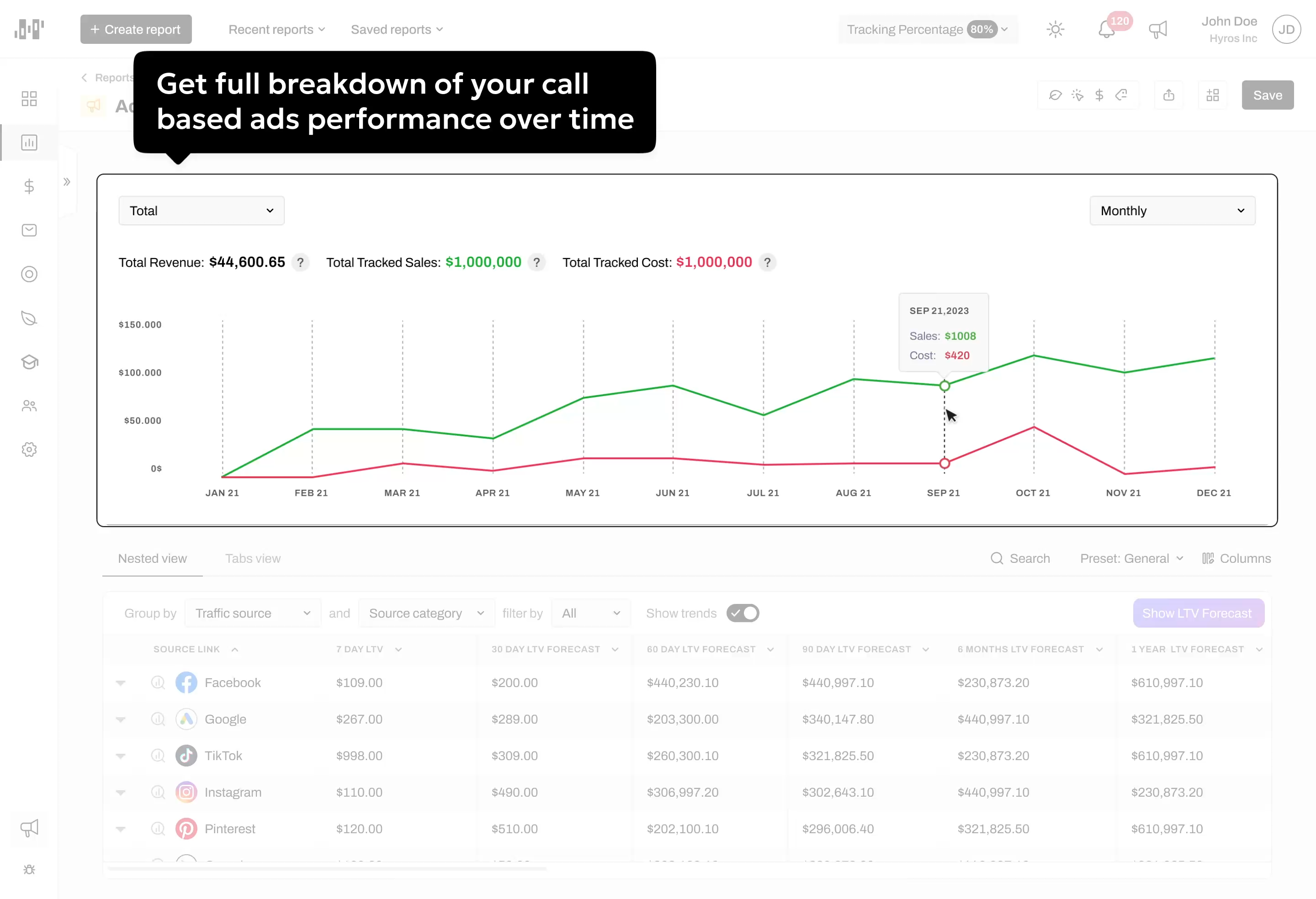
The platform can distinguish between booked calls, attended appointments, qualified prospects, unqualified leads, cancellations, and no shows. Scheduler integrations with tools such as Calendly and HubSpot can update these outcomes automatically.
Hyros can then send qualified call and sale data back to advertising platforms. This helps campaign algorithms optimize for leads that actually attend calls and convert, rather than treating every booking as equally valuable.
Wicked Reports handles calls through its CallRail integration. CallRail collects phone numbers and campaign parameters, while Wicked Reports matches that information with contacts stored in the connected CRM.
Once the phone number matches a CRM contact with an email address, Wicked Reports can attribute the call to the relevant campaign. Calls appear within individual customer histories and can be reported as new or reengaged leads.
Wicked Reports provides enough call attribution for ecommerce brands that already use CallRail. Hyros is the better option for businesses where booked calls and sales conversations form a major part of the conversion process.
Data retention
Wicked Reports provides lifetime data retention while the account remains active. This allows users to compare current campaigns with older customer and revenue data without losing previous attribution records. The platform keeps account data for another 45 days after cancellation before deleting it.
Wicked Reports also offers a pause option for $29 per month. New tracking and daily processing stop during this period, and reports cannot be accessed, but the existing data is stored until the business reactivates its subscription.
Hyros gives former customers more time to return without rebuilding their tracking history. Its current terms state that customer data is retained for 180 days after termination, although access normally ends after 30 days. Customers can request limited access during that first month to retrieve their data when technically possible.
After the 180 day period, Hyros says it permanently deletes the remaining customer data unless different written instructions or legal requirements apply.
Wicked Reports offers the clearer policy for businesses that want to preserve historical reporting while subscribed or temporarily paused. Hyros provides a longer recovery period after cancellation, but customers should export anything important within the first 30 days because dashboard access does not continue for the entire retention period.
Setup and ease of use
Neither Wicked Reports nor Hyros is difficult to use once data begins flowing correctly. The bigger challenge is setting up every data source properly, since missing scripts or campaign parameters can weaken the reports produced by either platform.
Wicked Reports requires users to connect their CRM, order system, and advertising accounts. Its tracking code must also be installed across landing pages, forms, and checkout pages, while email links may need additional tracking parameters.
Setup is relatively quick when a business uses supported platforms such as Shopify, Google Ads, Meta, or a popular CRM. Custom shopping carts and unsupported CRM systems require more work through Zapier, file imports, or an API connection. Wicked Reports provides an onboarding call to verify that the account is collecting reliable data.
Hyros has made setup easier for common ecommerce platforms. Shopify users can connect their store through a dedicated app, while its newer WordPress and WooCommerce plugin installs tracking scripts and webhooks with minimal configuration. Google Ads users can also apply the required tracking template during the integration process.
More complex funnels still require careful configuration. Businesses tracking calls, custom lead stages, several payment systems, or sales recorded inside a CRM may need support from the Hyros onboarding team before trusting the results.
Overall, Hyros offers the easier starting point for standard Shopify and WordPress setups. Wicked Reports has a more structured setup process, but it may demand more preparation when tracking several stages of the ecommerce customer journey.
Pricing plans
Wicked Reports and Hyros both adjust pricing according to business size, but they measure that size differently. Wicked Reports uses annual tracked revenue, while Hyros bases its rate on the monthly revenue passing through the platform.
Wicked Reports starts with the Measure plan at $499 per month for businesses with up to $2.5 million in annual revenue. Scale costs $699 per month, while Maximize costs $999 per month. Enterprise pricing starts at $4,999 for larger brands that need dedicated infrastructure and extra support.

The lower Wicked Reports plans may also require paid additions. Advanced Signal and 5 Forces AI each cost another $199 per month on Measure or Scale, although both are included with Maximize.
Hyros advertises business pricing from $230 per month with an annual plan. The rate rises with tracked monthly revenue, but the feature set remains largely the same across the available revenue limits. Full API access, custom attribution, integrations, and dedicated analyst support are included.
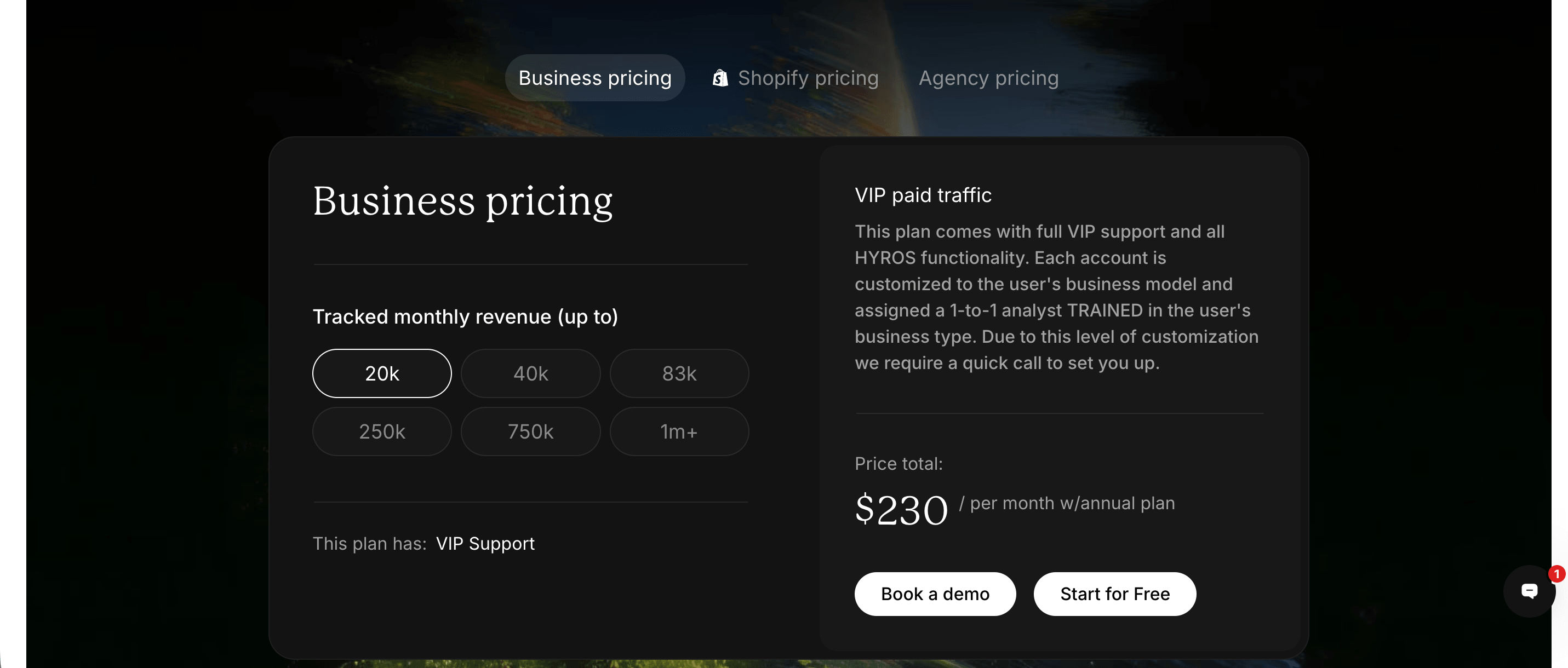
Hyros also promotes ecommerce pricing from $199 per month, although businesses must speak with its team before receiving a final rate.
At the entry level, Hyros is considerably cheaper. Wicked Reports provides clearer public prices for its main tiers, but its starting point is more than twice the advertised Hyros business rate.
Which attribution software should you get?
Wicked Reports and Hyros solve many of the same attribution problems, but they are built around different buying journeys. Your choice should come down to where conversions happen, how much customer history you need, and whether calls or repeat purchases play the bigger role.
Get Wicked Reports if:
- You run an ecommerce or subscription business.
- You need to track repeat purchases and customer lifetime value.
- You want to separate new customer revenue from returning customer revenue.
- Your CRM and ecommerce platform are the main sources of truth.
- You need attribution reports based on verified orders and customer records.
- You want to judge campaign performance across longer buying cycles.
Get Hyros if:
- You run complex paid advertising funnels.
- Customers convert through calls, webinars, or several landing pages.
- You need stronger tracking across devices and separate browsing sessions.
- Call bookings and sales conversations are central to your sales process.
- You want to send qualified lead and purchase data back to advertising platforms.
- Your team is more focused on paid media performance than long-term customer value.
Wicked Reports is the better fit for ecommerce brands that care about retention and lifetime value. Hyros is the stronger choice for businesses that rely on calls, delayed conversions, and longer paid funnels.
In some cases, neither platform will be the right choice. Smaller businesses, companies with limited ad spend, or teams that only need basic campaign reporting may find both tools too expensive and demanding to set up.
Get the better alternative to Wicked Reports and Hyros
Wicked Reports and Hyros can make sense for businesses that need broad attribution across long customer journeys. The tradeoff is higher pricing and more setup than many ecommerce teams actually need.
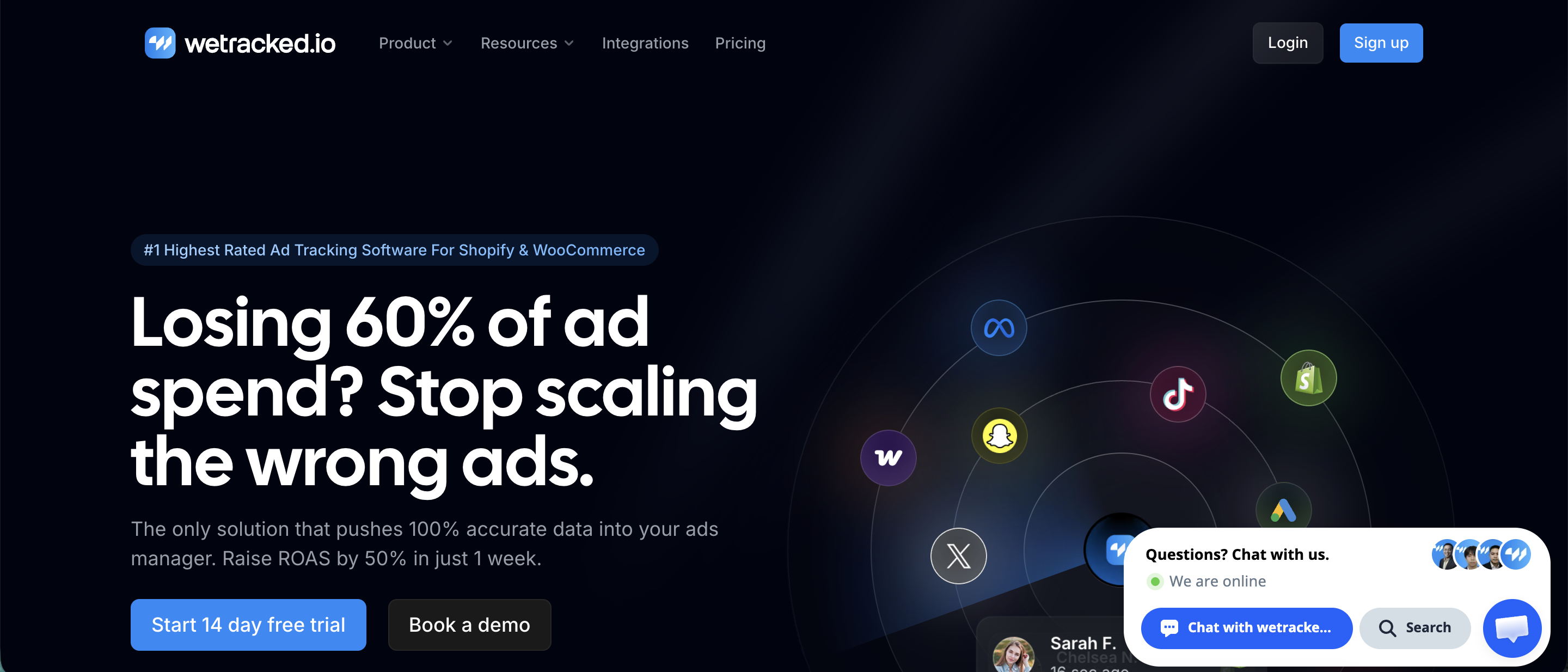
wetracked.io offers a more focused alternative for ecommerce ad tracking. It captures store events through server-side and first-party tracking, enriches the conversion data, then sends it directly to the advertising platforms where campaign decisions happen.
This helps recover sales data that may be lost because of ad blockers, browser restrictions, or cookie limitations. Orders and revenue can be connected with the ads that generated them, giving Meta, Google Ads, TikTok, and other platforms more reliable conversion signals.
The setup is much lighter than a traditional attribution platform. wetracked.io supports Shopify and WooCommerce, along with several checkout systems, and says supported stores can begin tracking within five minutes without coding.
Pricing is another major advantage. Monthly plans start at $49 for up to 500 orders, while annual billing brings the effective monthly price down to $39.20. Plans include unlimited ad spend and unlimited revenue, so costs are tied to order volume rather than traffic or advertising budgets.
wetracked.io does not try to replace every attribution and business intelligence tool. For ecommerce brands that mainly want cleaner conversion data inside their existing ad platforms, that narrower focus can be exactly what they need.
Try wetracked.io free for 14 days and see how much conversion data your current tracking setup is missing.


%20(1).png)
.png)


